WW1 Casualty: Serjeant 16984 John Stanley Orrett - Serjeant 16984 John Stanley Orrett
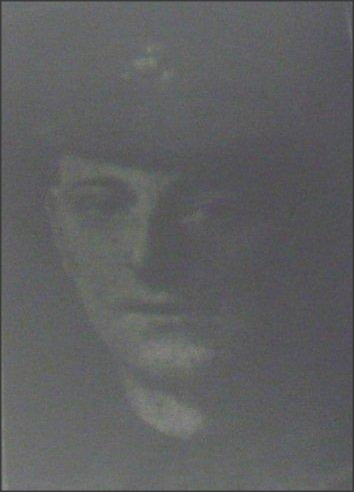
Prescot Reporter 16/12/1916
| Unit/Regiment |
18th Bn., King's (Liverpool Regiment) |
| Date of Death |
18/10/1916 |
Age at Death |
25 |
Burial/Memorial
& Reference |
Thiepval Memorial
Pier and Face 1D 8B and 9C |
| CWGC Family Details (if shown) |
Son of James and Alice Orrett, of 4, Garden Walk, Prescot, Lancashire. |
| Census Details |
1901 census -
The Orrett family lived at 4, Garden Walk, Prescot at the time of the census. Along with father James (37), a Commissions Agent, and his wife Alice (41), are children Annie (15), a dressmakers apprentice, James (12), John (9), Walter (5) and William (7)
1911 Census -
John Orrett lived at 21, Sutherland Street, Pimlico, London. John was aged 19 and working as a Clerk at Somerset House. This address was a Boarding House and several Clerks from Somerset House and the Admiralty lodged there.
|
| Birth/Marriage/Death Registrations |
Birth Registered Q2/1891, Prescot, 8b, 706 |
| SDGW - Where Born |
Prescot, Lancs |
| Enlisted |
Liverpool |
| Resided |
Prescot, Lancs |
| How Died |
Killed in Action |
Theatre of War |
France & Flanders |
| Research Ref. No. |
P213 |
Service DetailsJohn was born on 17th May 1891 in Prescot, the son of James and Alice Orrett. James was employed as a Solicitor's Clerk. John was the the elder brother of Walter Harold ORRETT
John was Head Boy at Cowley School, St. Helens, in 1907 and also attended Prescot Parish Church Bible Class
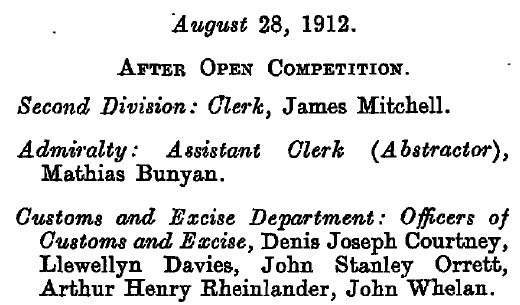
The London Gazette of 3rd September 1912 reported that John Stanley Orrett had been accepted as an Officer of HM Customs and Excise (see below)
The 18th (Service) Battalion of the King's (Liverpool) Regiment was formed by Lord Derby in August of 1914, and John Orrett attested on 31st. He was 20 years old and recorded that he worked as a Customs Officer. He had previously served with the London Volunteers, a Territorial unit. He was appointed Lance Corporal on 20th January 1915, then promoted to Corporal on 20th April, Lance Sergeant on 27th May and finally to Sergeant on 1st September 1915.
(For details of the 18th Battalion involvement up to August 1916, refer to the page of Private John Copple).
After the activity on the Somme, the battalion was relieved on 22nd August and moved back to billets at Pont Fixe and La Panniere, where they spent the rest of the month.
The next action in which we see the 18th involved was the Battle of Le Transloy, 1st to 18th October 1916. It was the 13th October before the 18th Battalion came into the action, relieving the 20th King's in the front line. The next phase of the attack on Le Transloy was due to start at 3.40 a.m. on the 18th October. The 18th Battalion were in the centre of a line which included the Green Howards on the left and the 2nd Wiltshires on the right.
Prior to the attack, the battalion had been in reserve at Flers Trench until the 15th, when they moved to support trenches at Goose Alley, then on the 17th they moved to their assembly trenches, which were in extremely poor condition.
At Zero hour, the battalion advanced steadily towards the German lines, but the Germans replied with a barrage that checked the first wave and resulted in them merging with the second wave. On one side of the advance, uncut barbed wire and withering machine gun fire slowed the advance, but the remainder continued onwards. But when they reached the German trenches, for some unaccountable reason they failed to jump in to the actual trenches, and instead began filtering back. It was felt that the men were utterly worn out after the continuous attrition. One description of the area said 'The ground was covered in shell holes. Combined with the greasy and sodden state of the ground and numerous bodies, the going was exceedingly difficult. There were no landmarks to give the troops direction. The mud and the slime clogged the rifles and guns, preventing them from being fired'.
Eventually, during the night of the 18th/19th, the battalion was relieved by the Manchester Regiment and moved back to support trenches at Goose Trench. They had lost heavily - 14 officers and 212 other ranks.
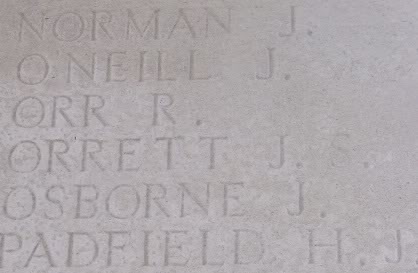
Amongst the dead was Serjeant Orrett. His body was never identified and he is remembered on the Thiepval Memorial.
On 2nd October 1917, the Army Records Office requested that any possessions of his should be returned to his father in Garden Walk. This seems to confirm that he was initially posted as 'Missing' and that after some 12 months, it was accepted that he must have been killed in action.
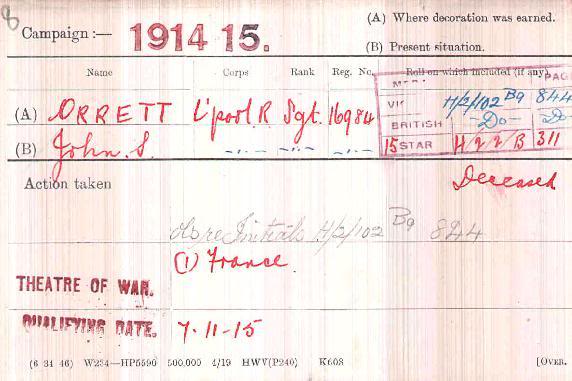
John Orrett's Medal Index Card. He was entitled to the 1915 Star, British War Medal and Victory Medal. His father acknowledged receipt of his medals in October 1922.
John Orrett's inscription on the Thiepval Memorial
Picture taken Monday 21/02/2011
Member Comments(0)
Please select a letter for a surname list:
|