WW1 Casualty: Private 17179 John Copple - Private 17179 John Copple

Picture (C) Joe Devereaux
| Unit/Regiment |
18th Bn., King's (Liverpool Regiment) |
| Date of Death |
01/07/1916 |
Burial/Memorial
& Reference |
Dantzig Alley British Cemetery
V W 6 |
| CWGC Family Details (if shown) |
Son of Joseph and Margaret Copple, of Green Cottage, Prescot, Lancs.
There is no personal inscription on John Copple's headstone |
| Census Details |
1901 Census -
Joseph Copple was a 45 year old brewer living at 11, Seddons Brow, Eccleston. His family comprised wife Margaret (46) and children Mary (10), William (18), an articled clerk, Joseph (13), Elizabeth (8), Margaret (6) and John (4)
1911 census -
The census simply records the family address as "Eccleston, Prescot". Joseph Copple, a 55 year old Brewer was widowed and lived with his children Christine (25), Susannah (21), Elizabeth (18) and John (14) |
| Birth/Marriage/Death Registrations |
Birth RegisteredQ3/1896, Prescot, 8b, 702 |
| SDGW - Where Born |
Prescot, Lancs |
| Enlisted |
Liverpool |
| Resided |
Prescot, Lancs |
| How Died |
Killed In Action |
Theatre of War |
France & Flanders |
| Research Ref. No. |
P058 |
Service DetailsJohn Copple was baptised at Our Lady's Church, Portico, on 24th June 1896. He attended Prescot Grammar School from 1904 to 1912.
The Copple family had a brewery in Portico Lane, Eccleston Park. Originally known as 'William and John Copple', the brewery was run by the brothers, then from 1877 to 1891 it was known as John Copple, after which it became 'Copple Brothers' until 1930.
John Copple attested for Military Service in Liverpool on 2nd September 1914. He was 19 years and 2 months old, unmarried and working as an Articled Clerk. He was 5ft 6in tall, wither 132 pounds, and had a 34inch chest, expandable by a further 2 inches.
He was of a fresh complexion, with Blue eyes and Black hair and had a mole on his right forearm. He was a Roman Catholic. He was passed as fit for military service after his medical the same day.
The 18th (Service) Battalion of the King's (Liverpool) Regiment was formed by Lord Derby in August of 1914. They embarked for France on 7th and 8th November 1915 as part of the 89th Brigade of the 30th Division.
The next entry in his service records shows that he was killed in action on 1st July 1916.
Private Copple's medal entitlement was to the 1914-1914-1915 Star, the British War Medal and the Victory Medal. His next of kin was listed as his father, Joseph, of Green Cottage, Prescot.
The Commanding Officer of the 18th Battalion, Lt. Col. E. H. Trotter gave the following narrative of the 18th Battalion on 1st July 1916, the infamous 'First Day of The Somme'. The narrative reproduced here is extracted from 'The History of the King's Regiment (Liverpool)', by Everard Wyrell, published 1934.
'The battalion was formed up in the assembly trenches by 7.30 a.m. At 7.20, I went down the line and saw that all was in order, then returned to Battalion Headquarters. I tried to observe the advance of the battalion at 7.30 but I was too late by about a minute in seeing the front line getting out of their trenches, but I saw the enemy attempting to barrage our front line just after the third line left and before the fourth line reached the barrage. The enemy's barrage did not appear to do much harm to our men before they left our front line, as I saw our fourth line, who were in sectional columns, press successfully through the shell area; but I heard afterwards there were casualties from the enemy's artillery on the racecourse. There are very few officers left now from No 1 Company, the leading company on the left, and none from No 4 Company, the support company, but from the narratives of the survivors, officers and men, I think the following is a pretty accurate story.
'In many places out men could leave the trenches without being seen from the enemy's front line trenches. This was on the Fleche side, and to deal with them the enemy had machine guns which it was impossible to locate before the action commenced. The hedge running in front of Montauban, which was the apparent place, was under barrage from our artillery. These machines guns dealt with men, unseen, leaving the parapet. On the right, where the men were more on the high ground, there was a machine gun firing directly on our men advancing from the frontline trench. This was afterwards captured, and its team, who fired up to the last minute and then attempted to surrender, were shot. An NCO had one hand on the gun and one in the air. The first line seems to have been taken with a certain amount of opposition, and one officer and some men surrendered, but previous to this on our advance some men were seen to leave the trench and retreat towards Montauban. A certain amount of bombing took place in the second-line trench and thirty men surrendered after being forced into dug-outs by our advancing parties. The line was not held by the barrage on the front two trenches or Alt trench.
Here a difficulty arose and the officers who remained alive with the men had difficulty in stopping their forward rush. The barrage was on, as ordered at the scheduled time, and the battalion had to wait until it lifted., during which time they were subjected from the left-flank to machine-gun fire which enfiladed them, beside which the enemy had placed a flanking party under cover of a tree hedge with its right running into Alt Alley, covered by a bombing party.
'Capt. A de Bels Adam, who was in the second line and whose duty it was to keep intercommunication with the 18th Division and cover on the left flank, immediately saw the situation and as agreed, attempted to deal with it by the bombing parties told off for this object. The bombing parties were, however, shot down by snipers. The gallantry of the men and officers and the foresight and battle knowledge of Capt. Adam is beyond all praise, for at this point and at this moment I think the whole of the operations for the taking of Montauban were in the balance. Our forward bombing parties had all been shot down by snipers and 2/Lt. G. A. Herdman, who had come forward to deal with the situation, was blown to pieces by an enemy bomb. 2/Lt. E. Fitzbrown, who led his company and was the first man to enter the enemy's front-line trench, where he had emptied his revolver , seeing the situation, took two bombs in his hand and attempted to bomb Train Alley and the hedge, and immediately met with the same fate as other bombers had done who had tried to do the same thing, from the enemy's snipers. Here it was that Capt. Adam's battle knowledge and determination saved the situation.
'He immediately sent to Lt. Watkins of the clearing party, for more bombers, who came up. Men, whose name deserves mention, reconnoitered at the risk of wounds (which they received) and death also, located the enemy's bombing party and reported to Lt. Watkins that Alt Trench was held by an advanced bombing party which covered the enemy's snipers in Train Alley with rifles fixed in Alt Trench.
'Lt Watkins attempted to go down and found the body of 2/Lt. Herdman, and threw a bomb which failed to reach the enemy bombing guard. Lt. Watkins acted as a subaltern would act, and grasping the situation immediately, he told off his longest throwers, who with the greatest luck, threw a bomb into the German bombing guard, killing two and pushing the rest back into Train Alley, thus making the advance possible and the bombing of Lt Watkins party drove the enemy into their dugouts; many were shot in the hedge by riflemen and thirty surrendered to Lt. Watkins once their dugouts were bombed.'
The narrative goes on to say that every fighting officer was hit by enemy shells or bullets except one, and he as accidentally bayoneted as he crossed a trench. The total number of casualties, killed and wounded, was estimated at over 500.
It is not possible to denote exactly which part of the battle resulted in the death of Private Copple, but the above extract is intended to give an indication of the ferocity of the action in which he fell.
He was buried close to where he fell, and then in 1919 as part of the concentration of British dead, his body was exhumed and reinterred in Dantzig Alley British Cemetery.
Lt. Col Edward Henry Trotter, who supplied the narrative above, was himself killed in action on the 8th July whilst leading the battalion to its assembly position in the trenches.
Prescot Reporter, 28/07/1917 -
A Family Notice in the Liverpool Echo, 28th July 1916
The Parish Magazine of 26th July 1917 reported that a Parents Meeting at the Grammar School had heard a list of seven names, these being old boys of the school who had been killed in action. Amongst these was Pte. John Copple of the King's (Liverpool) Regiment (City Battalion) who had fallen at the Somme battle of 1916
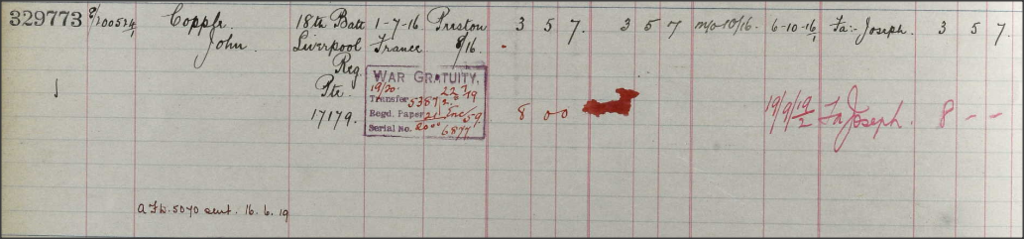
The Register of Soldiers Effects, listing John's father, Joseph, as his legatee
With regard to the family brewery business, 'This Is Lancashire' reported in 1999:-
Business apparently prospered between 1883 and 1887, when owner John Copple bought several plots of land surrounding the brewery.
When John died in 1891, aged 76, his sons, William, Edward and Joseph, took over, selling their beer through pubs, beer houses, clubs and shops in Eccleston, Huyton, Parr, Prescot, Rainhill, St Helens, Sutton, Whiston and Widnes.
The last of the brothers to die was Joseph, in 1925, when his estate was divided equally between his four daughters and a son, Joseph Edward. This brought about a classic fall from grace. For Joseph Edward, far from being a stabilising brotherly figure, was by all accounts, a spendthrift. Business quickly declined and just two years after their father's death the brewery shut down in 1927 with the land, buildings and several of the firm's public houses sold off.
The plight was not helped by the fact that, in common with many small breweries of the time, they could not compete with the larger companies such as Greenalls.
After its closure, the Copple's site was used for a time as a builders' merchants business. Then, around 1957, Orchard Close was built on part of the site, with Middlehurst Close occupying the remainder of it a few years later.'
Private Copple's Medal Index Card
John's parents, Joseph and Margaret, are buried in Windleshaw Cemetery and their headstone, pictured below, also commemorates their son, John.
The wording reads,
OF YOUR CHARITY PRAY FOR THE SOUL OF
MARGARET COPPLE WHO DIED APRIL 27 1910 AGED 57 YEARS
ALSO ELIZABETH DAUGHTER OF THE ABOVE WHO DIED JULY 11 1912 AGED 19 YEARS
ALSO JOHN (JACK) SON OF THE ABOVE
KILLED IN FRANCE JULY 1ST 1916 AGED 20 YEARS
ALSO JOSEPH COPPLE DIED SEPTEMBER 26 1925 AGED 69 YEARS
R.I.P.
Additional information and picture kindly provided by John Copple's family
John's service is commemorated on the Grammar School Roll of Honour
John Copple's grave at Dantzig Alley, courtesy of Tony Wainwright
Member Comments(0)
Please select a letter for a surname list:
|