WW1 Casualty: Private 24445 Louis Henry Smaje - Private 24445 Louis Henry Smaje

Pictured in the Prescot Reporter, 14th September 1917
| Unit/Regiment |
8th Bn., Royal Inniskilling Fusiliers |
| Date of Death |
16/08/1917 |
Age at Death |
26 |
Burial/Memorial
& Reference |
Tyne Cot Memorial
Panel 70 to 72 |
| Census Details |
1901 Census:-
The Smaje family lived at 2, Chester Street. The family comprised parents David, 38, an Electrical Cable Capper and Mary, aged 37, along with their children David (17) and Thomas (16), both General Labourers, Simon (12), Louis (9), Ethel (5), Arthur (3) and Herbert (2 months). |
| Birth/Marriage/Death Registrations |
Birth registered Q1/1891, Toxteth Park, 8b, 167
Marriage to May Whittle registered Q1/1913, Prescot, 8b, 1036
Children Frank (1913) and Harold (1915) both born in Prescot. |
| SDGW - Where Born |
Liverpool |
| Enlisted |
St Helens, Lancs |
| Resided |
Prescot, Lancs |
| How Died |
Killed In Action |
Theatre of War |
France & Flanders |
| Notes |
Formerly 5417, Royal Field Artillery
Remembered on the memorial at St Luke's Church, St. Helens |
| Research Ref. No. |
P312 |
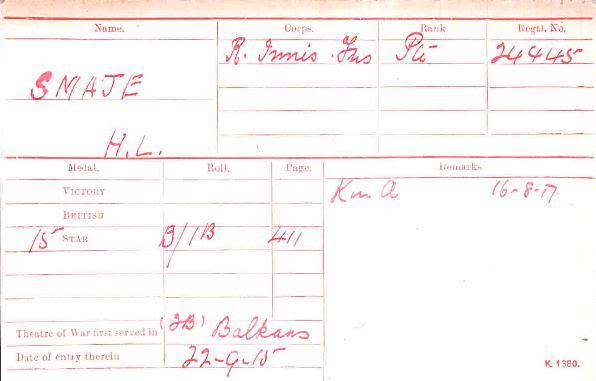
Service DetailsLouis Smaje's Medal Index Card (see below) records that his first Theatre of War was the Balkans, where he arrived on 22nd September 1915. The 8th Battalion of the Royal Inniskilling Fusiliers did not serve in the Balkans, and so it is safe to assume that Louis served there with the Royal Field Artillery. It is not clear from the surviving service information exactly when Louis transferred from the artillery to the infantry.
The 8th Battalion had been formed in 1914 at Omagh before moving to Tipperary. After training, they finally moved to England in September 1915 then onwards to join the British Expeditionary Force in France in February 1916.
In Flanders in the summer and autumn of 1917, a series of battles took place which collectively became known as the Third Battle of Ypres. The action in which the 8th Battalion of the Royal Inniskilling Fusiliers were involved in mid-August was the Battle of Langemarck.
Third Ypres was supposed to have as its strategic aim the liberation of the Belgian Channel ports and their denial to U-boat operation. One imperative that did exist was the need to attack the Germans and take the pressure of the French Army, which was beset by mutiny; another was Haig's need to secure a victory before the Americans arrived. The immediate tactical aim of the offensive was the recapture of higher ground from which the German artillery could observe and accurately bombard any target in the vicinity of the last Belgian town in Allied hands, Ypres. In the end its most significant result was its sucking in and pulverisation of the majority of the divisions of the German Army, in relentless and bloody attrition that fatally weakened its ability to wage grand war.
The British attacks in the summer and autumn of 1917 took place in the wettest weather in seventy-five years. The vital drainage channels of this low-lying area of Belgium were pounded out of existence by the British and German artillery. The water table of the Ypres salient turned into the sea of mud and blood that became known as Passchendaele, after the village that crowns the horseshoe of ridges that lie to the east of Ypres. The village is only 6 miles from the offensive's start line near Ypres but it took the Allied forces four and a half months to reach that goal, at a cost of over three hundred thousand casualties, including Private Louis Smaje.
The Battle of Langemarck began on the morning of 16th August 1917 at 4.45, with a tremendous artillery barrage. Not only were the many German strongpoints bombarded, but a creeping barrage was laid to keep the defenders' heads down as the British infantry advanced. The speed of the barrage advance would have been calculated to be the same as the infantry's pace. An enemy counter-barrage fell behind the British front line and was not a problem for the 8th Inniskillings, but a furious storm of machine-gun fire and snipers' bullets met them shortly after they had begun their attack.
The fortification in front of the 8th battalion was Borry Farm . This was a strongpoint consisting of three concrete dugouts linked by a breastwork. It was garrisoned by at least 100 men and five machine-guns. Both Beck House and Borry Farm were covered from Hills 35 and 37, and from the Potsdam and Bremen redoubts near Zonnebeke.
A and B companies of the 8th Battalion outflanked Borry Farm and managed to advance about 800 yards, keeping in contact with the 7th Inniskillings on their left. A German counter-attack inflicted heavy casualties on these companies, killing, wounding, or capturing all but 30 men.
C company launched frontal and flank attacks on Borry Farm and were reduced to a remnant that took cover in shell holes 50 yards to the west. Increasing German pressure led to the withdrawal of all survivors of the Battalion to their original positions. The battalion had suffered over 60% casualties. At the end of the day, the 16th Division was back where it had started.
In his report of the operation the battalion commander attributed the failure of the attack partly to poor communications. German snipers appear to have particularly targeted messengers.
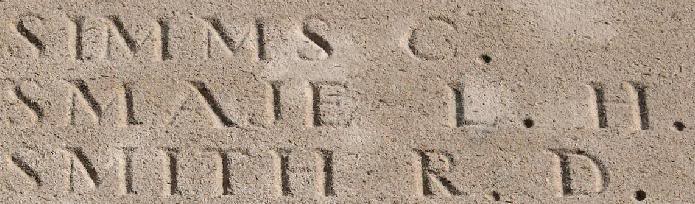
Louis Smaje has no known grave and is commemorated on the Tyne Cot Memorial near Passchendaele.
Louis Smaje's Medal Index Card shows his entry to the Balkans Theatre of War (Gallipoli) on 22nd September 1915, entitling him to the 1914-1915 Star in addition to his British War Medal and Victory Medal.
The Parish Magazine of 25th March 1918 reported that in addition to the already long list of men of the parish who had fallen, six additional names were to be added. Included in them was 'Pte. Louis Henry Smaje, 25, Enniskillen Fusiliers, killed 16th August 1917, of 36 Scotch Barn Lane, leaves a widow and two children, now living in St Helens.'
Probably as a result of his widow and children moving to St Helens, Louis Smaje is also commemorated on the memorial at St Luke's church in St. Helens.
Louis Smaje's inscription on the Tyne Cot Memorial
Member Comments(0)
Please select a letter for a surname list:
|