WW1 Casualty: Private 44068 William Hulme - Private 44068 William Hulme
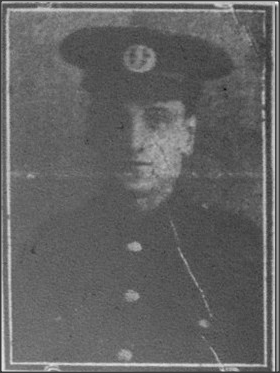
© Prescot Reporter, courtesy of Ste M.
| Unit/Regiment |
2nd Bn., South Lancashire Regiment |
| Date of Death |
22/10/1918 |
Age at Death |
31 |
Burial/Memorial
& Reference |
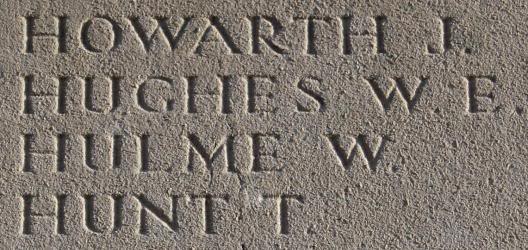
Tyne Cot Memorial
Panel 92 to 92 and 162A |
| Census Details |
1911 Census -
24 year old William was single and working as a Telephone Assistant at the Wire Works. He lived at 23, Beaconsfield Street, Prescot, with his parents James (69) and Ann (67). Of their 11 children, only 5 were still living, with William the only child still at home |
| Birth/Marriage/Death Registrations |
Birth Registered Q1/1887, Prescot, Volume 8b, Page 671 |
| Enlisted |
Prescot, Lancs |
| How Died |
Killed In Action |
Theatre of War |
France & Flanders |
| Research Ref. No. |
P160 |
Service DetailsAt the beginning of 1918, the 2nd Battalion were located in the Lagnicourt sector, opposite the notorious Hindenberg Line. In February, owing to the shortage of manpower, the 8th (Service) Battalion ceased to exist, its men being transferred into the 2nd. Battalion.
It was clear that there was additional activity in the German lines, and a corresponding increase in the activity of German aircraft. The German offensive finally began on the 21st March and the battalion was in the thick of the fighting until the night of the 26th, when they were withdrawn, marching to billets at Lanches which they reached on the 28th.
In the 5 days of the initial offensive, they had lost 13 officers and 360 other ranks, killed, wounded and missing. Upon the arrival at Lanches of reinforcements of 15 officers and 343 other ranks, the battalion was reorganised with 4 companies, 'A' to 'D'.
The battalion was ordered to replace the Australians at Ploegsteert and by 2nd April they occupied trenches some 2,000 yards east of the ruined village. They remained here until the 8th, when they marched back to the Rosignol rest area. However early the next morning, heavy shellfire was heard to the south, towards Armentieres and word was received that the enemy had broken through. The battalion was ordered to stand to, ready to move at a moment's notice.
The battalion remained on stand by in support of the 8th Border Regiment and 11th Cheshires up to midnight on the 9th.
The next morning the Germans advanced towards Ploegsteert and the battalion was ordered to occupy a position on the high ground, 2,000 yards west of the village. At 3.30 p.m. it was decided that a counter attack against Ploegsteert should take place, timed for 5 p.m. The attack was reasonably successful, but was held up by a large number of skilfully handled German machine guns.
The battalion remained in the thick of the action until they were relieved on 21st April.
On 9th May, they entrained for the Soissons area, returning to the scenes of some of their earliest encounters with the Germans back in 1914, although there were now few survivors of that earlier campaign.
Around the middle of May, an increase in activity behind the German lines was reported and escaped French prisoners told that immense supplies of ammunition was being stock-piled. By 26th May, the battalion was in possession of intelligence that told of an attack the following morning, and they moved forward to Ventelay to protect the crossings of the River Aisne.
The attack commenced at 1 a.m. on the 27th with artillery, gas and a huge infantry assault. By midday the situation was critical and the enemy had crossed the Aisne in two places. Fierce fighting continued throughout the day but by dusk, the remnants of the battalion had withdrawn to the high ground south of Ventelay.
On the 28th and subsequent days the attacks continued all along the lines, forcing a general retirement to a line sough of the River Vesle. As a result of heavy losses on the Aisne, the battalion received strong drafts and moved to Flanders for rest. This took place throughout July and the battalion did not go back into the line until 8th August, when it was near Kemmel.
This day was the day the tide turned, beginning with a series of successful attacks along a broad front, north and south of the Somme. Within a few days, it was clear that the German line had fallen back along its entire length, from Switzerland to the sea. The main British role was an assault on the German positions in Flanders. The battalion was confined throughout August and September in small scale actions, clearing locations which had been the scene of bitter fighting in the previous years.
Ultimately, they reached Rollinghem on 20th October and marched through villages bedecked with flags and cheering Belgian inhabitants. However, they now had to cross the River Escaut.
During the night of 21st/22nd October, three platoons, accompanied by Royal Engineers, crossed the river. Well placed German defences prevented the establishment of the bridge-head and they had to withdraw, having lost 4 men killed and 28 wounded.
Private Hulme was one of those killed. He has no known grave and is remembered on the Tyne Cot Memorial to the missing.
An extract from the 'Workers Union Record'
His service is commemorated on the United Reformed Church Roll of Honour and the BICC Memorial Plaues
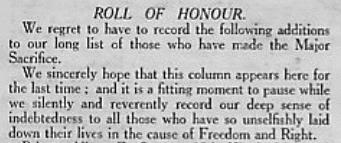
The Parish Magazine reported on 28th December 1918 'Five more names for our Roll of Honour' and included 'Pte. William Hulme, 31, 2nd S. Lancs., killed in action 25th October 1918, of 28 St Helens Road, leaves a widow and one child'.
William Hulme's Medal Index Card.
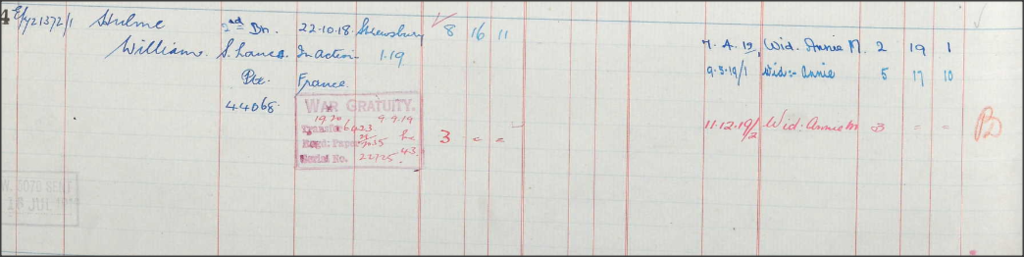
William's entry in the Register of Soldiers Effects lists his widow as Annie, though I have as yet been unable to locate a record of their marriage
An extract from BICC 'Link' Magazine, November 1918.
William Hulme's inscription on the Tyne Cot memorial.
Member Comments(0)
Please select a letter for a surname list:
|