WW1 Casualty: Corporal 34604 Thomas Henry Hopwood - Corporal 34604 Thomas Henry Hopwood

| Unit/Regiment |
9th (Service) Bn, York and Lancaster Regiment |
| Date of Death |
09/06/1917 |
Age at Death |
30 |
Burial/Memorial
& Reference |
Menin Gate
Panels 36 and 55 |
| CWGC Family Details (if shown) |
Husband of Jane Hopwood of 14, Cyprus Street, Prescot. |
| Census Details |
1901 Census -
Thomas, aged 14, lived with his parents Richard (33) and Rachel (34) at Townfield Cottages, Huyton Quarry. He was employed as an Iron Worker.
Also there were his brother Benjamin (8) and sisters Mary (5) and Elsie (1 month).
1911 census -
I have been unable to locate the family in the 1911 census, although other records appear to indicate that they lived at 69, Beaconsfield Street. This was the home of Jane's family before she married. |
| Birth/Marriage/Death Registrations |
Marriage to Jane Case in Q4/1907, Prescot, 8b, 1194 |
| SDGW - Where Born |
Wolverhampton |
| Enlisted |
Middlesborough |
| Resided |
Prescot, Lancs |
| How Died |
Killed In Action |
Theatre of War |
France & Flanders |
| Notes |
Formerly 18840 Yorkshire Regiment
Additional research undertaken by John Yates |
| Research Ref. No. |
P154 |
Service DetailsSDGW shows that Thomas Hopwood was born in Wolverhampton. It has not been possible to trace a record of his birth registration. He married Jane Case at the Wesleyan Chapel in Rainhill on 19th October 1907. At that time, he gave his address as 68, Beaconsfield Street, Prescot.
Jane gave birth to a daughter, Elsie, on 7th May 1908 in Prescot.
It is not clear why, but Thomas attested into the army on 21st December 1914 in Middlesborough, despite giving his address as Beaconsfield Street, Prescot. He joined the Yorkshire Regiment as Private 18840. Aged 29 years and 10 months, he stood 5 foot 3 inches tall, and had a 37 inch chest measurement, expandable by 2 inches. He reported his wife Jane as his next of kin.
Thomas was posted to the 3rd Battalion of the regiment on 30th December 1914, then transferred to the 6th Battalion on 28th August 1915. The battalion sailed for the Dardanelles the same day, arriving there on the 29th. A promotion to the paid appointment of Lance Corporal followed on 8th September 1915. He was then transferred to the 9th Battalion of the York and Lancaster Regiment on 23rd September 1915 with a new service number of 34604.
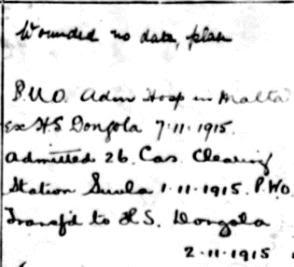
His record notes that he was wounded (details unknown) on 1st November 1915 and treated at 26 Casualty Clearing Station at Suvla in the Dardanelles. He was moved to hospital on Malta on board the Hospital Ship Dongola, arriving there on 7th November. The Dongola was used to ferry casualties from the Gallipoli peninsula while the Dardanelles campaign was in operation.
Part of Thomas Hopwood's service record, detailing his movements after being wounded on Gallipoli.
Thomas was transferred to the Ghain Tufficha Convalescent Camp on Malts on 21st January 1916, where he contracted Jaundice. His wife was notified of this on 20th March 1916. He was finally discharged back to duty on 21st May 1916. He remained with his unit in the Mediterranean until 2nd July 1916, when he arrived at Marseilles in France as his unit was moved to support the battle of the Somme.
It has not been possible to trace the battalion's movements for the remainder of 1916, but in February 1917 they went into Divisional reserve, entraining at Poperinghe for Millain, from where they marched via Bayenghem to billets at Zouasques near St Omer. Training was in the form of preparation for open warfare. They remained here until 18th March. A Brigade Football Competition was held, but the battalion lost 1-0 to 8th battalion, Kings Own Yorkshire Light Infantry.
On 18th March the Battalion marched to Herzeele via Watten and Millain. Here it trained and rested in billets. On 29th, Brigade Sports were held then on 31st practice in attack was begun.
On 1st April Major Middleton & 2/Lt Park rejoined and the Battalion was moved to Ottowa Camp. On 2nd they were on Observatory Ridge and Mount Sorrel, BHQ at Rudkin House then on the 6th they relieved a Battalion of the 39th Division on the left. The next day, following a raid by the 47th Division, the enemy retaliated, badly damaging front line trenches.
On 9th April, with the front line barely repaired, the enemy opened a very heavy bombardment on Front Line, support and Communication Trenches. The attack was to the right of the Battalion but was driven back after penetrating as far as Deep Support Line in the centre.
At 7.45pm they attacked 'D' Company of the battalion and serious damage was done to the front, parapets blown in and Davidson St. and Winnipeg St. trenches blocked. However, the Germans were repulsed and left behind 4 dead and 2 prisoners on the battalion front with heavy losses in No-Man's land. They also left behind explosives to be used to destroy mine shafts.
The battalion lost 23 other ranks in these attacks and were then relieved on the 10th.
On 2nd May the Battalion moved to Forges to begin to rehearse for an impending attack. 3 days were spent in the front line during which time a shell fell on 'D' Company HQ dugout on the 26th, killing 2/Lt Brenigan and M Proctor and wounding 2/Lt Bunce. On 29th May, by which time they were back in the Bund, Battalion HQ was blown in by a shell and all papers and records destroyed.
June opened with the Battalion relieved out of the line under a heavy gas shell bombardment, which caused a couple of casualties. Out of the line the Battalion visited a contour model of Messines in a wood near Busseboum, and visited a field near Boeschoepe to go over a "flagged course". Just before the battle the Battalion was in a field near Ouderdom when it was shelled by Perishing Percy, a long range gun.
On 5th June the Battalion was in the front line ready for the Battle of Messines, 'A', 'B' and 'C' Companies were in Wellington Crescent and 'D' in Maple Trench. Battalion HQ was situated in Halfway House. On 6th June Assembly positions were taken up from the North end of Canada Street to The Gap.
On the 7th about 2.30am the Battalion was in position. They formed the right front, with Battalion HQ in Canada Street. 'A' & 'B' Companies were to establish blocks at junction of New Trench and Image Avenue. 'C' Company was to bomb Immediate Trench. 'D' Company were designated as 'moppers-up'.
In the evening the Battalion was relieved having suffered 50% casualties, including CO Lt Col Bowes-Wilson killed by machine-gun fire, These were mainly sustained during the enemy's bombardment of his lost positions. At Kenistraathoek lorries took the survivors back to the Scottish Lines with Major D Lewis in command.
Corporal Hopwood is recorded by CWGC as Killed in Action on the 9th June. It has not been possible from the battalion diary to be certain about the action in which he fell, however it is likely that it was in the shelling of the 7th. It is interesting to note that the Parish Magazine reports him as being killed on the 7th which seems more likely. He has no known grave and is remembered on the Menin Gate.
The Parish Magazine of 28th June 1917 reported "The following are deaths in action, all in France or Belgium" and included "Corporal Thomas Hopwood, 30, of 14 Cyprus Street, the 9th York and Lancasters. Killed 7th June 1917, married"
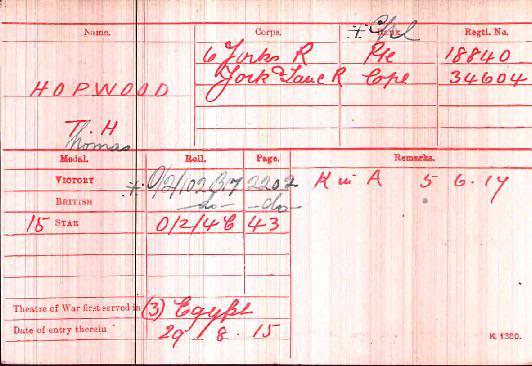
Thomas Hopwood's Medal Index Card showing his service with two regiments, and also noting the date of his arrival in the Gallipoli area on August 1915. His entitlement was to the 1914-1915 Star, British War Medal and Victory Medal. Note that the date of death differs from that shown by CWGC.
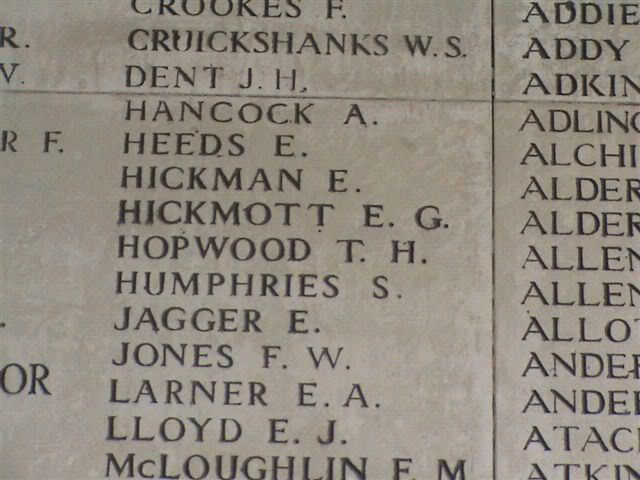
Thomas Hopwood's inscription on the Menin Gate.
Prescot Reporter September 1917
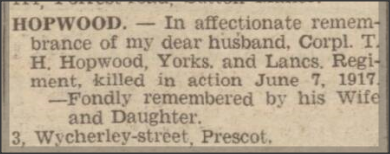
A Family notice in the Prescot Reporter, 9th June 1939
Thomas' widow, Jane, never remarried and the image below shows the family entry in the 1939 National Register. Their daughter, Elsie, was now married to Albert Chew and the family were living at 3, Wycherley Street
Member Comments(0)
Please select a letter for a surname list:
|