WW1 Casualty: Private 3305 Mathew Heyes - Private 3305 Mathew Heyes

| Unit/Regiment |
1st/5th Bn., South Lancashire Regiment |
| Date of Death |
23/10/1915 |
Age at Death |
19 |
Burial/Memorial
& Reference |
Thiepval Memorial
Pier and Face 7A and 7B |
| CWGC Family Details (if shown) |
Son of the late Mr. and Mrs. George Heyes. |
| Census Details |
1901 Census -
6 year old Matthew was living at 147 Higher Parr Street, St Helens. Also there were father George (50) a Coal Hewer, mother Elizabeth (49), and siblings Joseph (22), Thomas (20), Hannah (17), Samuel (15), Mary (12) and Elizabeth (8). |
| Birth/Marriage/Death Registrations |
Birth Registered Q3/1895, Prescot, 8b, 720 |
| SDGW - Where Born |
Prescot, Lancs |
| Enlisted |
St Helens |
| How Died |
Killed in Action |
Theatre of War |
France & Flanders |
| Research Ref. No. |
P149 |
Service DetailsThe 5th Battalion, South Lancashire Regiment, had just started its annual training in camp when war broke out in August 1914. It was sent to Edinburgh until October, then moved to Tunbridge Wells until February 1915. It was then ordered to France, sailing on the 13th aboard s.s. King Edward. Arriving at Le Havre the same day.
Over the next few days the battalion marched to billets at Le Bizet, and then undertook instruction in trench warfare. The system was for companies from a battalion to be attached to other battalions for spells in the line, before the sector was allocated to the battalion on its own. In addition to the trench duty, the battalion undertook its share of pioneer work and training in rapid fire.
The Battalion was moved around regularly without seeing action, until 28th April when it was moved to Vlamertinghe, Belgium in readiness to take part in the 1st Battle of Ypres, which had started on the 22nd.
On 2nd May, the Germans launched a violent attack, accompanied by a cloud of chlorine gas, and the battalion was moved into the line for the first time. On 3rd May, it was moved to the new line in front of Wieltje, and then on the 4th it was again moved to Shell Trap Farm. At dawn, they engaged the Germans but by 4pm the enemy was within 400 yards of the British lines, from where they began a heavy bombardment of the British lines.
More shell fire continued through the next day, culminating in heavy concentrated fire about 5 p.m. which resulted in a considerable number of men being buried, many of them killed and wounded. The enemy fire continued until midnight and four attempts were made by the Germans to take the farm, but all were repulsed.
At 2 a.m. on the 6th, the Battalion was relieved and moved to La Brique, having incurred considerable casualties.
On the 8th May, the battalion was once more sent up to the Wieltje sector as it was thought that the enemy had broken through, but it proved to be a false alarm and on the 9th it returned to La Brique, leaving 'C' Company and a machine-gun detachment at Wieltje. Early on the 10th, the battalion moved to the bank of the Yser canal where it remained until the 13th, when it was moved back to the support lines.
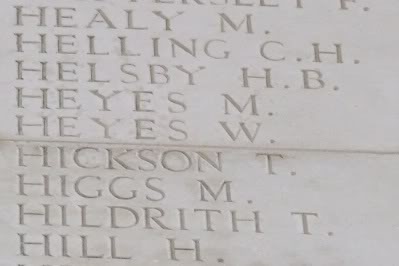
After 25th May, there were no more serious offensive actions from either side as all parties were exhausted. The battalion were billeted at Forceville in mid-Jul to early August, when it moved to trenches in the Auchonvillers section. They remained her, with rest billets at Maillly-Maillet, until 29th October when they retired to Bertencourt for training and work party assignment. The casualties suffered in this period were a result of the intermittent artillery and mortar fire, as well as constant sniping. Private Heyes was one of the casualties of this period. His body was never identified and he is remembered on the Thiepval Memorial to the missing of the Somme.
Mathew Heyes' inscription on the Thiepval Memorial
Picture taken on Monday 21/02/1011
Member Comments(0)
Please select a letter for a surname list:
|