WW1 Casualty: Private 26080 George Arthur Hamer - Private 26080 George Arthur Hamer

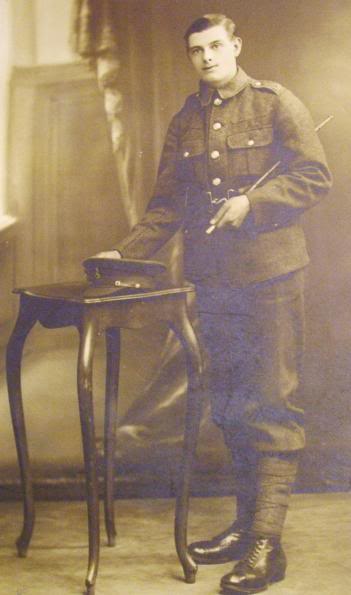
Picture kindly provided by the Hamer family
| Unit/Regiment |
18th Bn., King's (Liverpool Regiment) |
| Date of Death |
01/07/1916 |
Age at Death |
23 |
Burial/Memorial
& Reference |
Peronne Road Cemetery
IV I 28 |
| CWGC Family Details (if shown) |
Son of Joseph and Mary Hamer, of 34, Garswood St., Dingle, Liverpool.
Headstone Inscription
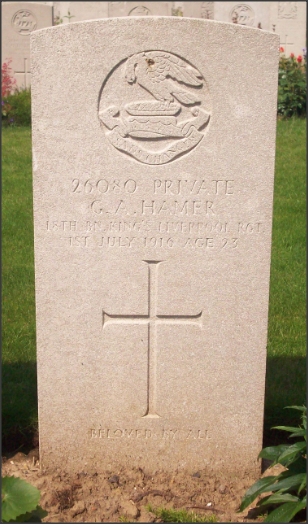
LOVED BY ALL |
| Census Details |
1901 Census -
The family lived at 53, Briarwood Road, Wavertree and comprised Joseph Hamer, a 34 year old engineer, wife Mary, aged 33, and children Joseph(10), George (8) and Violet (2).
1911 Census -
George was 18, single and working as a Grocers Assistant. He still lived with his parents at 42, Teilo Street, Liverpool |
| Birth/Marriage/Death Registrations |
Birth Registered Q1/1893, Prescot, 8b, 723 |
| SDGW - Where Born |
Prescot, Lancs |
| Enlisted |
Liverpool |
| Resided |
Dingle, Liverpool |
| How Died |
Died of Wounds |
Theatre of War |
France & Flanders |
| Research Ref. No. |
P139 |
Service Details"Soldiers Died in the Great War" records that George Hamer was born in Prescot. This is confirmed by both the 1901 and 1911 census entries, which also show that his older brother and younger sister were born in Liverpool. I have been unable to find a Prescot address for the Hamer family so can only assume that their stay in the town was short lived.
The Commanding Officer of the 18th Battalion, Lt. Col. E. H. Trotter gave the following narrative of the 18th Battalion on 1st July 1916, the infamous 'First Day of The Somme'. The narrative reproduced here is extracted from 'The History of the King's Regiment (Liverpool)', by Everard Wyrell, published 1934.
'The battalion was formed up in the assembly trenches by 7.30 a.m. At 7.20, I went down the line and saw that all was in order, then returned to Battalion Headquarters. I tried to observe the advance of the battalion at 7.30 but I was too late by about a minute in seeing the front line getting out of their trenches, but I saw the enemy attempting to barrage our front line just after the third line left and before the fourth line reached the barrage. The enemy's barrage did not appear to do much harm to our men before they left our front line, as I saw our fourth line, who were in sectional columns, press successfully through the shell area; but I heard afterwards there were casualties from the enemy's artillery on the racecourse. There are very few officers left now from No 1 Company, the leading company on the left, and none from No 4 Company, the support company, but from the narratives of the survivors, officers and men, I think the following is a pretty accurate story.
'In many places out men could leave the trenches without being seen from the enemy's front line trenches. This was on the Fleche side, and to deal with them the enemy had machine guns which it was impossible to locate before the action commenced. The hedge running in front of Montauban, which was the apparent place, was under barrage from our artillery. These machines guns dealt with men, unseen, leaving the parapet. On the right, where the men were more on the high ground, there was a machine gun firing directly on our men advancing from the frontline trench. This was afterwards captured, and its team, who fired up to the last minute and then attempted to surrender, were shot. An NCO had one hand on the gun and one in the air. The first line seems to have been taken with a certain amount of opposition, and one officer and some men surrendered, but previous to this on our advance some men were seen to leave the trench and retreat towards Montauban. A certain amount of bombing took place in the second-line trench and thirty men surrendered after being forced into dug-outs by our advancing parties. The line was not held by the barrage on the front two trenches or Alt trench.
Here a difficulty arose and the officers who remained alive with the men had difficulty in stopping their forward rush. The barrage was on, as ordered at the scheduled time, and the battalion had to wait until it lifted., during which time they were subjected from the left-flank to machine-gun fire which enfiladed them, beside which the enemy had placed a flanking party under cover of a tree hedge with its right running into Alt Alley, covered by a bombing party.
'Capt. A de Bels Adam, who was in the second line and whose duty it was to keep intercommunication with the 18th Division and cover on the left flank, immediately saw the situation and as agreed, attempted to deal with it by the bombing parties told off for this object. The bombing parties were, however, shot down by snipers. The gallantry of the men and officers and the foresight and battle knowledge of Capt. Adam is beyond all praise, for at this point and at this moment I think the whole of the operations for the taking of Montauban were in the balance. Our forward bombing parties had all been shot down by snipers and 2/Lt. G. A. Herdman, who had come forward to deal with the situation, was blown to pieces by an enemy bomb. 2/Lt. E. Fitzbrown, who led his company and was the first man to enter the enemy's front-line trench, where he had emptied his revolver , seeing the situation, took two bombs in his hand and attempted to bomb Train Alley and the hedge, and immediately met with the same fate as other bombers had done who had tried to do the same thing, from the enemy's snipers. Here it was that Capt. Adam's battle knowledge and determination saved the situation.
'He immediately sent to Lt. Watkins of the clearing party, for more bombers, who came up. Men, whose name deserves mention, reconnoitered at the risk of wounds (which they received) and death also, located the enemy's bombing party and reported to Lt. Watkins that Alt Trench was held by an advanced bombing party which covered the enemy's snipers in Train Alley with rifles fixed in Alt Trench.
'Lt Watkins attempted to go down and found the body of 2/Lt. Herdman, and threw a bomb which failed to reach the enemy bombing guard. Lt. Watkins acted as a subaltern would act, and grasping the situation immediately, he told off his longest throwers, who with the greatest luck, threw a bomb into the German bombing guard, killing two and pushing the rest back into Train Alley, thus making the advance possible and the bombing of Lt Watkins party drove the enemy into their dugouts; many were shot in the hedge by riflemen and thirty surrendered to Lt. Watkins once their dugouts were bombed.'
The narrative goes on to say that every fighting officer was hit by enemy shells or bullets except one, and he was accidentally bayoneted as he crossed a trench. The total number of casualties, killed and wounded, was estimated at over 500.
It is not possible to denote exactly which part of the battle resulted in the death of Private Hamer, but the above extract is intended to give an indication of the ferocity of the action in which he fell.
He was initially buried close to where he fell, but his body was exhumed in 1920 and reburied in Peronne Road Cemetery
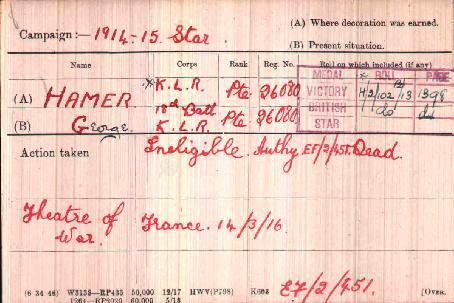
The medals roll shows that Private Hamer qualified for the 1914-1915 Star as he arrived in the theatre of war with his battalion on 7th November 1915. This, however, is not shown on his Medal Index Card (see below).
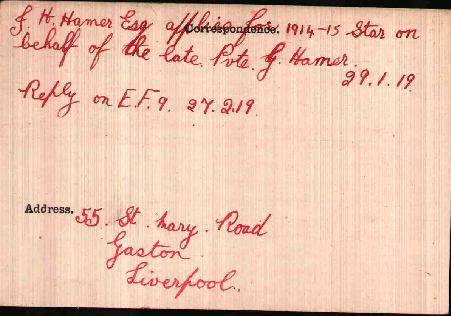
Although the Medal Index Card is stamped as a 1914-1914-1915 Star Card, the box in the upper right does not indicate a Medal Roll for that award, only holding details of the British War Medal and Victory Medal. This is probably because the date of entry into the theatre of war is shown as 14th March 1916. On 29th January 1919, George Hamer's father applied for the 1914-16 Star on his son's behalf, as indicated on the reverse of the Medal Index Card (below). Although the front of the card has been marked 'Ineligible', it is clear that the award was made by the entry into the medal roll, referenced earlier.
The card also shows that the family had moved to Dingle by 1921.
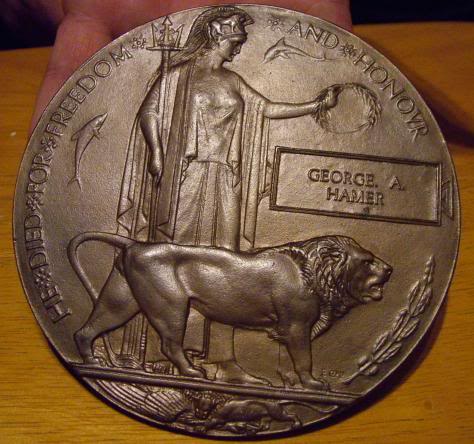
Pictures (above and below) kindly provided by "Delboy", a Pal of the Great War Forum
George Hamer's Memorial Plaque
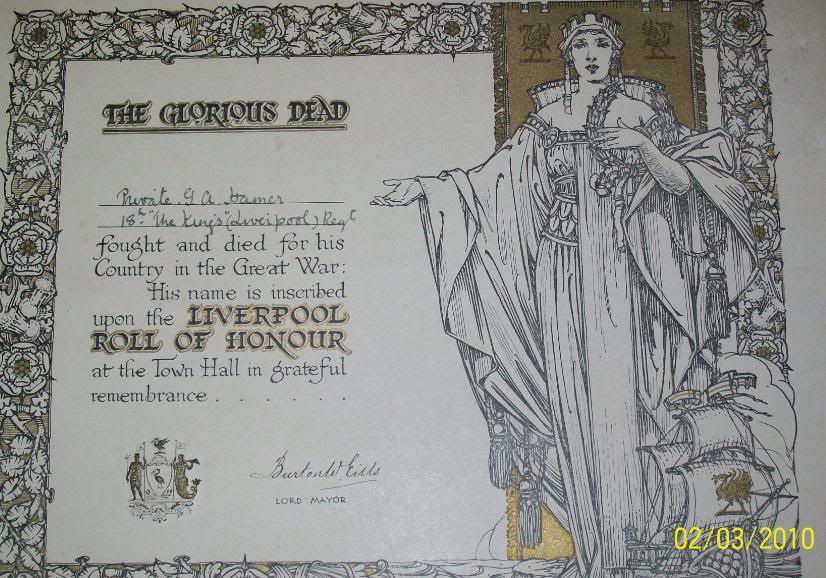
George Hamer's Memorial Scroll
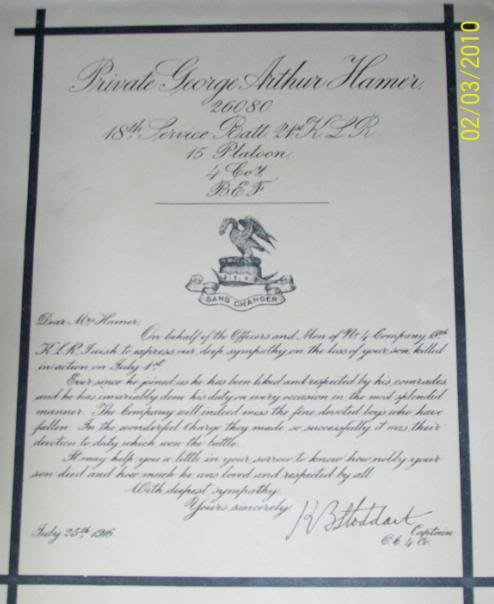
A letter concerning George Hamer's death sent by his Commanding Officer
Private Hamer is buried in Peronne Road Cemetery, in the row adjacent to Lt. Col. Trotter, whose account of the attack on 1st July is provided in that section. His grave stone is shown below, courtesy of Tony Wainwright
It would appear that Pte Hamer was originally buried close to where he fell and then he was exhumed and reburied at Peronne Road in 1920.
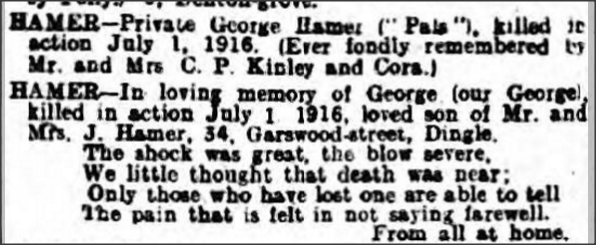
Family announcements in the Liverpool Echo in July 1917, the first anniversary of Pte Hamer's death
Member Comments(0)
Please select a letter for a surname list:
|