WW1 Casualty: Private 21956 Henry Byron - Private 21956 Henry Byron

| Unit/Regiment |
11th Bn., South Lancashire Regiment |
| Date of Death |
24/06/1917 |
Age at Death |
29 |
Burial/Memorial
& Reference |
Dickebusch Military Cemetery Extension
II A 39 |
| CWGC Family Details (if shown) |
Son of Mrs. M. Green, of 20, Market Place, Prescot, Lancs. |
| Census Details |
1901Census -
At 22 Market Place, Prescot, Mary Green (44) lived with her husband John (45). Also there were her three sons from her first marriage, John Byron (19), Henry (13) and Edward (11). Mary Green also had four children to her second husband. Robert Green (7), Jessie (5), Thomas (3) and William (1).
1911 Census -
Harry (24), a General Labourer, lived with his 72 year old Grandmother Ann Byron at 15, Bond Street, Prescot. |
| SDGW - Where Born |
Prescot, Lancs |
| Enlisted |
Prescot, Lancs |
| How Died |
Died of Wounds |
Theatre of War |
France & Flanders |
| Notes |
It is noted that the names 'Harry' and 'Henry' are interchangeable and Byron appears to have used both. |
| Research Ref. No. |
P032 |
Service DetailsHenry was the brother of John Byron and half brother of Robert Green
The 11th (Service) Battalion of the South Lancashire Regiment was formed in September 1914 from the third contingent of volunteers called for by Lord Kitchener.
Initial training took place on Salisbury Plain and in early 1915, the Battalion became a 'Pioneer' Battalion with the 30th Division. It had been decided that each of the New Army divisions should have an extra battalion included in its establishment to carry out road-making and other semi-technical work frequently called for in the field. The 11th Battalion was known as the 'St Helens Pioneers' in honour of the fact that the majority of the men came from St Helens.
On the 30th of July 1915, Henry Byron attested as Private 21956 into the 11th Battalion of the South Lancashire Regiment at Prescot. He recorded that he lived at 20 Market Place, Prescot, was 25 years and 10 months old, unmarried and working as a Brick Maker. He stood 5 foot 4 and a half inches in height, weighed 148 pounds and had a 40 inch chest measurement. His physical development was 'Good' and vaccination marks from infancy were noted, 4 on each arm. Eyesight was rated as 6 out of 6 in both eyes. Next of kin was noted as his father, John Green of the same address.
The Battalion finally left for France in November 1915, disembarking at Le Havre on the 7th. The Battalion strength was 30 officers and 1,007 other ranks. Many of the men, including Private Byron, did not sail with this first detachment.
The battalion served for the remainder of 1915 in the Somme Valley, carrying out work in the trenches. They suffered a few casualties, mainly to German snipers, but otherwise their first few weeks in the field proved uneventful.
In the Spring and early Summer of 1916, the Battalion were heavily involved in preparations for the forthcoming Somme offensive. As a Pioneer Battalion, this was an exceptionally busy time. On 27th March 1916, whilst still in the UK, Private Byron was reported for 'Overstaying his leave from 6.45 a.m. on 27.3.16 to p.15 p.m. on 27/3/16'. For this offence, he was confined to barracks for seven days and forfeited one day's pay. He subsequently embarked for France on 5th April 1916, arriving there the following day.
Ultimately, in May 1917 the Battalion moved to Palace Camp, near Dickebusch in Flanders. They were now in the infamous Ypres Salient. Although their main tasks were the construction of roads and light railways, they were involved in the construction of fire trenches, and in fact were tasked with this on their first night in the line.
The battalion was based in a school to the east of Ypres in an area known to be 'an unhealthy spot'. They stayed there until 13th June when severe casualties were caused by salvoes of high explosives and gas shells. They moved on the 14th to new dugouts on the railway embankment, but these were under fire just as much as the school.
In June, casualties were 2 officers and 17 other ranks killed, with 3 officers and 126 other ranks wounded. Almost all of the casualties were incurred whilst in their billets, which illustrates how dangerous it was, even out of the front line.
The next entry in his surviving records say that he died of wounds on 24th June 1917. It is not clear exactly where or when Private Byron was wounded, but he is shown to have 'Died of Wounds' and is buried in Dickebusch Military Cemetery Extension. This cemetery was used extensively by ambulance units, suggesting that he was removed from the front line and transferred to the ambulance unit, but ultimately succumbed to his injuries.
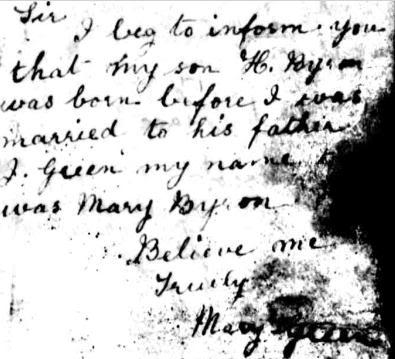
On December 17th, 1919, the army records office at Shrewsbury wrote to his mother, Mary Green. This was in response to Mrs. Green previously supplying the records office with a 'next of kin' form on which her surname of 'Green' was noted.
The records office wrote,
'Re: No 21956 H Byron, dec.
With reference to the attached form recently filled in by you. It is noted that you sign yourself Mary Green, mother of the above-deceased soldier. The solder's name, as shown in my records, is H Byron. I shall be glad if you explain the difference in names please. An early reply will oblige.'
On December 21st, Mrs. Green wrote back, signing herself 'Mary Green, formerly Byron'.
She wrote,
'Sir
I beg to inform you that my son H. Byron was born before I was married to his father, J. Green. My name was Mary Byron.
Believe Me.
Truly
Mary Green'
An extract from the letter written by Harry Byron's mother in 1919.
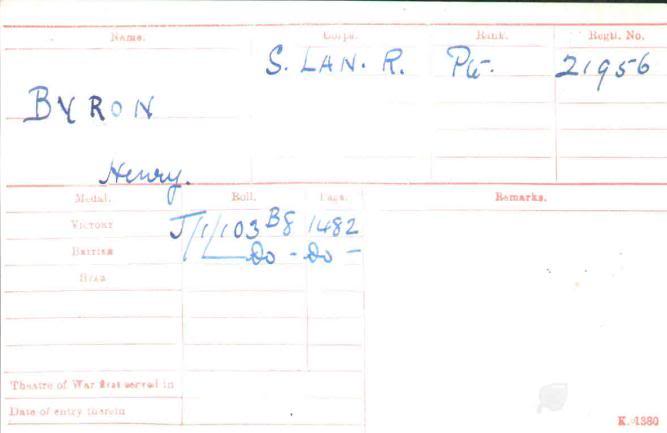
Harry Byron's Medal Index Card recording his entitlement to the British War Medal and Victory Medal
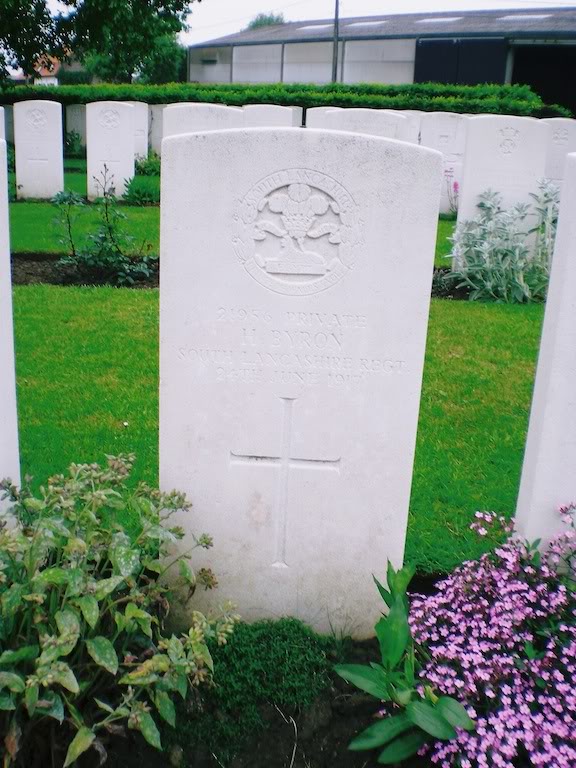
Harry's grave at Dickebusch
Picture (c) George Simpson
Member Comments(0)
Please select a letter for a surname list:
|