WW1 Casualty: Private 9829 Robert Green - Private 9829 Robert Green

| Unit/Regiment |
1st Bn., King's (Liverpool Regiment) |
| Date of Death |
18/11/1914 |
Age at Death |
20 |
Burial/Memorial
& Reference |
Menin Gate
Panel 4 and 6 |
| Census Details |
1901 Census -
The Green family lived at 22, Market Place, Prescot. John, aged 7, was the son of John and Mary Green.
1911 Census -
Robert was 17 years old and based at Orford Barracks, Warrington, with the 1st Battalion of the King's Liverpool Regiment |
| SDGW - Where Born |
Prescot, Lancs |
| Enlisted |
Liverpool |
| Resided |
Prescot |
| How Died |
Killed in Action |
Theatre of War |
France & Flanders |
| Research Ref. No. |
P128 |
Service DetailsRobert Green was a pre War regular soldier, probably joining the army around 1906.
He was the half brother of Henry Byron and John Byron
The regimental history for the 1st Battalion states that they were quartered in Talavera Barracks in Aldershot in August 1914 and that mobilising the battalion took three days, all being "ready for anything" by 8th August. But then the reservists joined them and a further few days were spent in bringing these men up to date with items such as the new short rifle, which they had not used before.
Eventually, the battalion left Aldershot on 12th August at 6 a.m. and marched to Farnborough Station were they entrained for Southampton at 8 a.m. , arriving at 9.30. They embarked aboard the S.S. Irrawaddy and steamed away at mid-day, arriving it Le Havre at dawn the following day.
The battalion was in the midst of the fighting at Mons, and the retreat from there in late August, moving on to the Battle of the Marne in early September. It was at this point that the troops settled into what became know as Trench Warfare, digging in for the first time. The initial German assault had lost steam slightly by this time, and the regimental history records several days of inactivity.
The battalion fought on the Aisne and also in a series of minor actions in the same areas between mid-September to mid-October, all of which led up to the First Battle of Ypres. This battle consisted of the Battle of Langemarck (21st to 24th October, followed by the Battle of Gehuvelt (29th - 31st October), with many smaller actions in between the two.
The battalion diary for the 1st November finally recorded 'All quiet during the night'. The German attempt to break through on to Ypres had been defeated and bloodily repulsed. The days now consisted of constant shell-fire and even without any set piece actions, the casualties continued to mount, with 17 men killed or wounded on the 1st.
This continued daily, with the battalion forming the line along the southern edge of Polygon Wood. During the night of 10th/11th November, the signs indicated an enemy attack was forthcoming, with an extremely heavy German bombardment continuing throughout the night, lifting at 6 a.m.
The initial attack took place at 7.a.m. and was met by a wall of fire from the Kingsmen until the officers were able to call a halt to it. As daylight broke, the sight of a continuous wall of German dead met the battalions, their bodies lying several deep in parallel with the battalion front. Not one of the enemy had reached the trenches.
An intense bombardment followed, this the beginning on an historic day ion the battalion history - the day of the Prussian Guard attack. When the shelling ceased at 9 a.m. twenty five battalions of the Prussian Army, some 17.500 men, moved forward on the Menin Road, faced by less than 8,000 allied troops including the 1st Battalion of the King's.
The attack was beaten off time and again and at noon a message was received from battalion HQ 'Situation well in hand, on no account should you quit your trenches'. The Kingsmen, who had repulsed several enemy attacks, were indignant at this and replied, 'No intention of quitting our trenches, but what about our rations?'
When the roll was called at nightfall, the battalion had lost 29 men killed and wounded, but had inflicted dreadful losses on the enemy.
Private Robert Green was one of the dead. His body was never identified and he is remembered on the Menin Gate memorial to the missing.
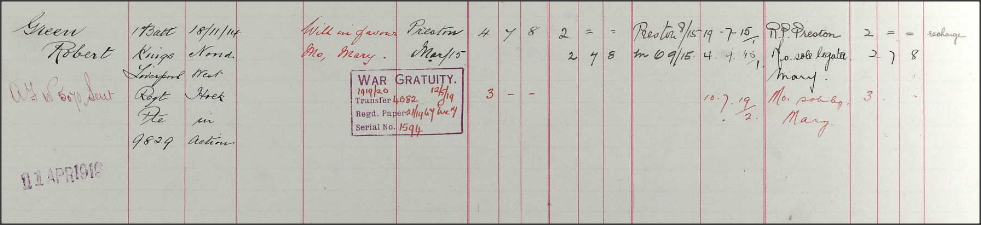
The Register of Soldiers Effects showing that Pte Green's mother was the recipient
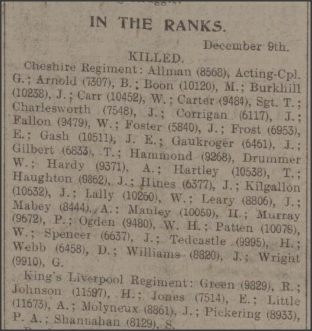
Pte Green was included in a list of casualties published in the Liverpool Daily Post in December 1914
Private Green's Medal Index Card showing his arrival in France just 4 days after the outbreak of the war. This entitled him to the 1914 Star in addition to his Victory Medal and British War Medal.
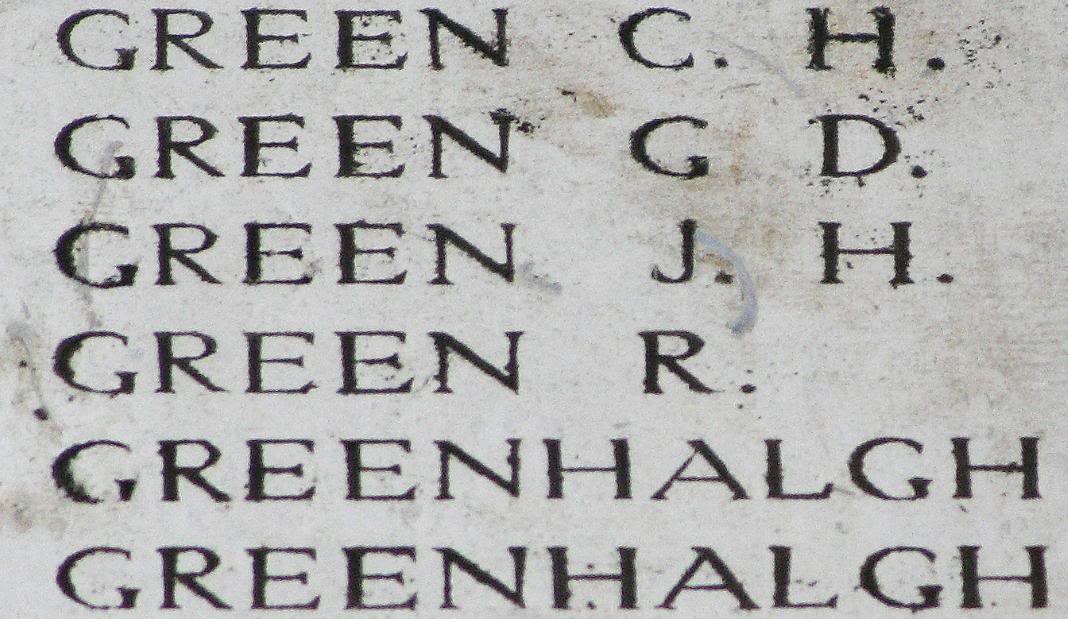
Robert Green's inscription on the Menin Gate
Member Comments(0)
Please select a letter for a surname list:
|