Prescot 1914-1919 - Prescot Roll of Honour
Prescot 1914-1919
This page shows stories, pictures and information related to the Prescot which will have been known by our Great War servicemen. This will include Great War themed stories, newspaper extracts, etc. which may not necessarily relate to a single servicemean on the site.
If you have anything that you would like to see included on this page, please contact me
*********************************************************************************************************************************
Prescot Recruiting
The item below appeared in the Prescot Reporter in December 1915
*********************************************************************************************************************************
Award for Gladys Bullock
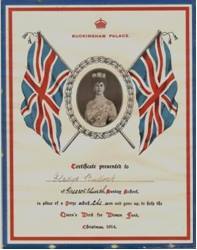
The following picture and article are taken from Betty Brown's article on the Parish Magazine website
In the December 2014 magazine, there was
the usual mention of what was printed in the Parish magazine 100 years ago by the Vicar, Harry Mitchell and it was about the 'Queen's Work for Women Fund'. In this connection, our Vicar John has recently received, from a lady in the Isle of Man, a framed certificate which she purchased from an antique shop, and is relative to the 'Queen's Work for Women Fund'. The name on the Certificate is 'Gladys Bullock' and it had been presented to this young lady in December (Christmas) 1914. The inscription on it says: 'Certificate presented to Gladys Bullock of Prescot Church Sunday School in place of a prize which she won and gave up, to help the 'Queen's Work for Women Fund', Christmas 1914'.
The census of 1911 reveals a family of Bullock living at 1 Barrows Court, which was off Kemble Street: Mr Joseph and Mrs Martha Bullock, Joseph aged 10 and Gladys aged 6. She would have been aged 9 in 1914, and possibly the recipient of this Certificate. A Gladys Bullock married James Swift in 1931. It would be interesting if anyone living in Prescot could identify with Gladys and her family.
During WWI Queen Mary threw herself into voluntary work for the war effort. First, she organized a Needlework Guild to provide clothing for the soldiers. This was a Relief Fund she supported which raised a quarter of a million pounds during the first launch which was on 2 October 1914. Following this success, she formed the "Queen's Work for Women Fund" which gave employment to wives whose men were fighting overseas. Many women in the textile and clothing industry had lost their jobs as export markets closed.
Representatives of working women were called to the palace and the "Queen's Work for Women Fund" was created. Contracts to supply clothing and other items for the Army Supply Department were issued and the Queen placed a personal order for 75000 woollen body belts as part of her Christmas gift for the troops. This gave much employment in the clothing industry.
WWI prompted a new wave of voluntary activity and the foundation of many charities that provided for servicemen and their families. Some are still active today.
Betty Brown
(Ref.1914-18 How Charities Helped to Win WWI, by Carol Harris internet
*********************************************************************************************************************************
German War Trophy
An article appeared in the Prescot Reporter of 23rd October 1915 under the above heading. It read,
"An interesting photograph of a German helmet brought from France by Pte. Rees Walmsley Davies, whose photograph is also given.
Pte. Davies, who is the son of Mr A. Davies, Joiner, of Warrington-road, Prescot, is a reservist of the R.A.M.C., 12th Field Ambulance, and was called up at the commencement of hostilities. He was formerly a teacher of chemistry at the Gamble Institute and is well know in St. Helens.
In the present campaign, Mr Davies was in the thick of the fighting, attending to the wounded, from the opening, until he was invalided home, arriving at Southampton on Tuesday of last week. He was present at St Quentin, Compiengne, Crecy, and La Ferte Jouarre and other places where fighting has taken place. On arrival at Southampton he was conveyed to a hospital at Sheffield.
On Thursday last week his mother, accompanied by his wife, visited him and it was then that they received the helmet. He stated that it belonged to a German who was brought in one day mortally wounded. There are marks of blood on the spike of the helmet, which when it came into Mr Davies possession, had a large German eagle on a crest in front, but this was lost. At the time Private Davies was invalided home he was near the River Aisne.
Mrs Davies also a a son, Garth, serving on H.M.S. "Carnarvon".
The pictures below accompanied the article, with the caption below the first image reading "Pte Davies brother reviewing the war trophy with youthful admiration"
Image and article courtesy of SteM
*********************************************************************************************************************************
Soldiers and Sailors Family Association
The Soldiers and Sailors Family Association was founded in 1885 when the Second Expeditionary Force sailed for Egypt and The Times launched a fund raising campaign for the families of the servicemen.
Shortly after the Great War, and with the recent formation of the Royal Air Force, it was renamed to Soldiers, Sailors and Airmen's Families Association, more commonly known as SSAFA.
During the Great War, braches of SSFA existed in most towns, including Prescot, and they supported the families of serving and deceased servicemen.
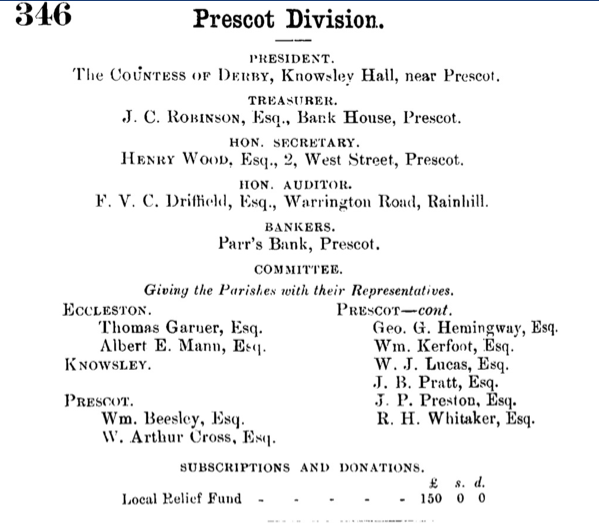
The image below shows the make up of the Prescot Branch at the end of 1914.
*********************************************************************************************************************************
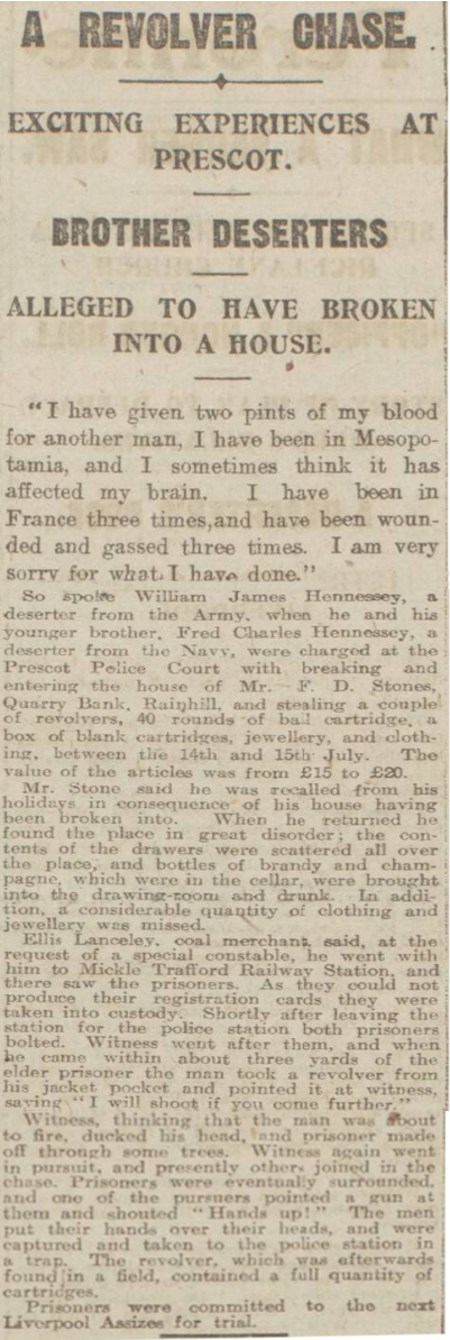
This story appeared in the Liverpool Echo on 30th August 1918
|