WW1 Casualty: Private 13130 James Nulty - Private 13130 James Nulty

James Nulty pictured in the 'Garston and Woolston Weekly Reporter' in 1916
| Unit/Regiment |
'A' Coy, 9th Bn., Royal Dublin Fusiliers |
| Date of Death |
09/09/1916 |
Age at Death |
36 |
Burial/Memorial
& Reference |
Villers-Brettoneaux Military Cemetery
VIA D4 |
| CWGC Family Details (if shown) |
Son of Patrick and Kate Nulty; husband of Bridget Nulty, of 6, Hill St., Prescot, Lancs.
Gravestone Inscription
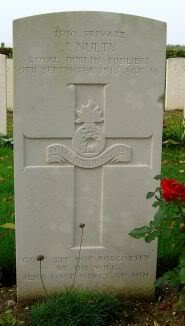
GONE BUT NOT FORGOTTEN
BY HIS WIFE
JESUS HAVE MERCY ON HIM |
| Census Details |
1891 census -
James, aged 13, lived at 16, Browns Court, Prescot with his widowed mother Catherine (35) and siblings Anthony (11), Mary (7) and Patrick (3). The family were boarders at the residence of Eliza O'Neill. Also resident as a boarder was Patrick Hester, who would later marry Catherine Nulty and have two other children with her.
1901 Census -
Living at 11, Stone Street, Prescot, were Catherine Nulty, recorded as a 45 year old widow, and her children James (23, a Coalminer), Patrick (13), Ellen (8) and Thomas (6)
1911 Census -
James Nulty was aged 34 and working as a Collier. Along with his wife, Bridget, they lived at 13, Hill Street, Prescot. |
| Birth/Marriage/Death Registrations |
Birth registered Prescot, Q2/1878, 8b, 649
Marriage to Bridget Gilligan registered Prescot, Q4/1904, 8b, 1142 |
| SDGW - Where Born |
Prescot, Lancs |
| Enlisted |
St Helens, Lancs |
| Resided |
Prescot, Lancs |
| How Died |
Killed in Action |
Theatre of War |
France & Flanders |
| Research Ref. No. |
P211 |
Service DetailsJames Nulty was born in Prescot in 1881, the eldest son of Patrick Nulty and Catherine (Kate). He was the eldest of the Nulty brothers who served in the Great War - Anthony Nulty, Thomas Nulty and Patrick Nulty
He originally served with the 8th Battalion of the Royal Dublin Fusiliers before transferring to the 9th Battalion on an unknown date
"Corisande", a Pal at the Great War Forum, telle me ....
"The 16th (Irish) Division arrived in France in December 1915 and was assigned to the Loos sector. The soldiers experienced trench warfare and suffered casualties during each 8-day period in the front line. They were in the trenches at Hulluch when the Germans launched a gas attack on April 27th, 1916. Of the 1980 casualties, 570 were killed and many of the wounded died later from respiratory diseases. The Germans had put up placards opposite the Irish trenches to bring news of the Easter Rising which had begun in Dublin. The Division remained at Loos until August when it moved to the Somme area. The Division had suffered 6,000 casualties (1,496 killed). "
While they were in the Somme sector, they took part in the capture of Guillemont on 3rd September 1916, then the 9th Battalion, Royal Dublin Fusiliers, moved on to Ginchy.
Extract from the War Diary
'9th September 1916
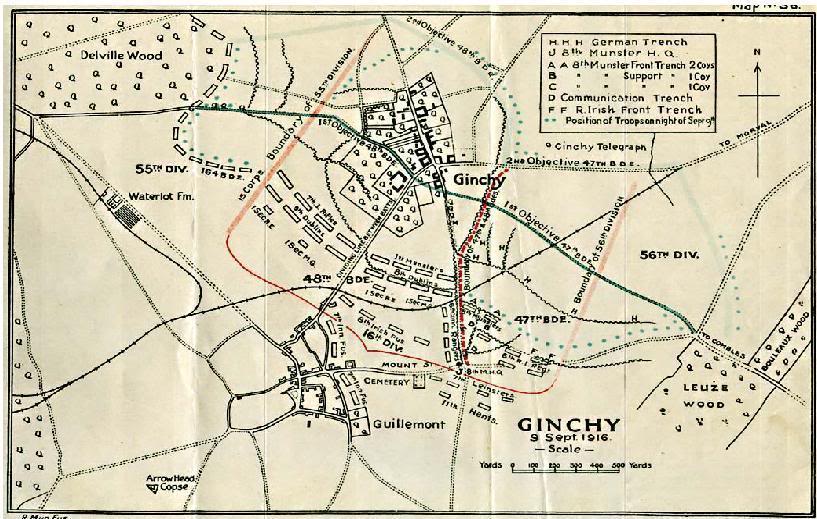
The battalion was in the support trench which it had dug. On the morning of 9th September the disposition of the units of the 48th Brigade for the assault on GINCHY which had been ordered were as follows.
In front trench with orders to take the first objective and consolidate it. 7th R. Irish Rifles, 1 section T.M. Battery, 1st R. Munster Fusiliers, 1 section T.M. Battery. In support trench with orders to take the second objective and consolidate. 9th R. Dublin Fusiliers, 1 section M.G Coy. 1 section 156 Coy, R.E., 8th R. Dublin Fusiliers, 1 section M.G. Coy, 1 section 156 Coy R.E..
At zero (4.45pm) the line advanced under the artillery barrage on the first objective, each battalion assaulting with 4 companies in the front line, on a frontage of one platoon, platoons at 40 yards distance.
First Phase. Right Battalion (1st R.M.F.). At the onset very heavy Officer casualties were suffered. The right company experienced considerable opposition owing to the inability of the 8th R.M.F. to advance. This company was therefore wheeled to the right and dug in. Owing to the shortage of officers the other companies lost direction and went on beyond their objective. Left Battalion (7th R.R.R.) closely followed by 7th R. Irish Fusiliers reached the first objective with slight resistance & with very few casualties.
Second Phase. Right Battalion (8th R.D.F.) advanced to the second objective at 5.25 p.m. and gained it without encountering very serious opposition. Left Battalion (9th R.D.F) advanced to the second objective at 5.25pm but suffered very heavy officer casualties in doing so. Captain W. J. MURPHY (commanding) being killed as the battalion reached GINCHY. The battalion owing to the loss of officers carried on beyond the second objective and had to be brought back and owing to the fact that 55 Division had not come up. The left flank had consequently to be brought back slightly. The line gained was then consolidated.'
The battalion lost 52 officers and men in the attack on Ginchy. The second objective, in which James died, was a German support trench.
Records held by the Commonwealth War Graves Commission show that after the battle, James was buried in a small cemetery to the south of Ginchy. In November 1923, as part of the continuing battlefield clearance, he was reburied in Villers-Brettoneaux Military Cemetery. Alongside him in Grave VIA D 5 is Private Michael Gallagher, also of the 9th RDF and killed on the same day, presumably in the same action.
James' widow, Bridget, had a sister, Catherine, who was married to Michael Gilgannon and they had a son John Terence Gilgannon, who was also killed during the war.
A rare Imperial War Museum photograph showing the attack on Ginchy
A plan of the positions on the day of the attack
Announcement in the Prescot Reporter of 14th September 1917
The Parish Magazine of 27th October 1916 stated 'Since the October magazine was published in which the names of 47 of our heroic dead were recorded, 7 more have fallen in the long battle of the Somme. The list then followed, including 'Pte. James Nulty of Hill Street, Dublin Fusiliers'.
James Nulty's Medal Index Card. This shows his arrival in France as 20th December 1915, which entitled him to the 1914-1915 Star in addition to the Victory Medal and British War Medal.
James Nulty's grave at Villers-Brettoneux.
James' widow, Bridget, never remarried. She was listed in the 1939 National Register (below) living at 95, Shaw Lane, Prescot, which was the home of Jane Worth, mother of Ernest Worth who died in 1917.
Member Comments(1)
Stephen Nulty
Thu, 23 May 13, 8:50. | James Nulty was my Great Uncle, the eldest brother of my grandfather, Thomas Nulty.
It was while looking into my family tree in the late 1990's that I came across James and started to research his story, wondering why his name was inscribed on the Civic Memorial.
That led me to wonder about the other men on the memorial, and so began the research for the Prescot Roll of Honour...... |
Please select a letter for a surname list:
|