Also Served: Herbert Ray - Herbert RAY
24 Station Road, Prescot Sergeant 368, 1/5th Bn., South Lancashire Regiment Herbert attested to the Territorial Army on 7th April 1908 at Prescot. He lived at 24, Station Road, Prescot, was just under 20 years old and worked as a Switch Board Attendant at the Wire Works. He had two years previous service with the old Yeomanry, the territorial Army being only created in 1908 under the Haldane reforms.
The 1911 census showed Herbert living at the above address with his mother, Adelaide Louise Dutton, and her husband Harry. Herbert is shown to be the stepson of Harry. At this time, he is shown to be a Stationary Engineman.
In the Autumn of 1914, Herbert married Marion Elizabeth Blundell in Prescot.
On the outbreak of war in 1914, he was promoted to the rank of 'Second Sergeant'. When the battalion went to France 13th February 1915, Herbert was once again promoted to Sergeant, then in May of that year he was made Colour Sergeant, finally becoming Company Sergeant Major on 29th August 1915.
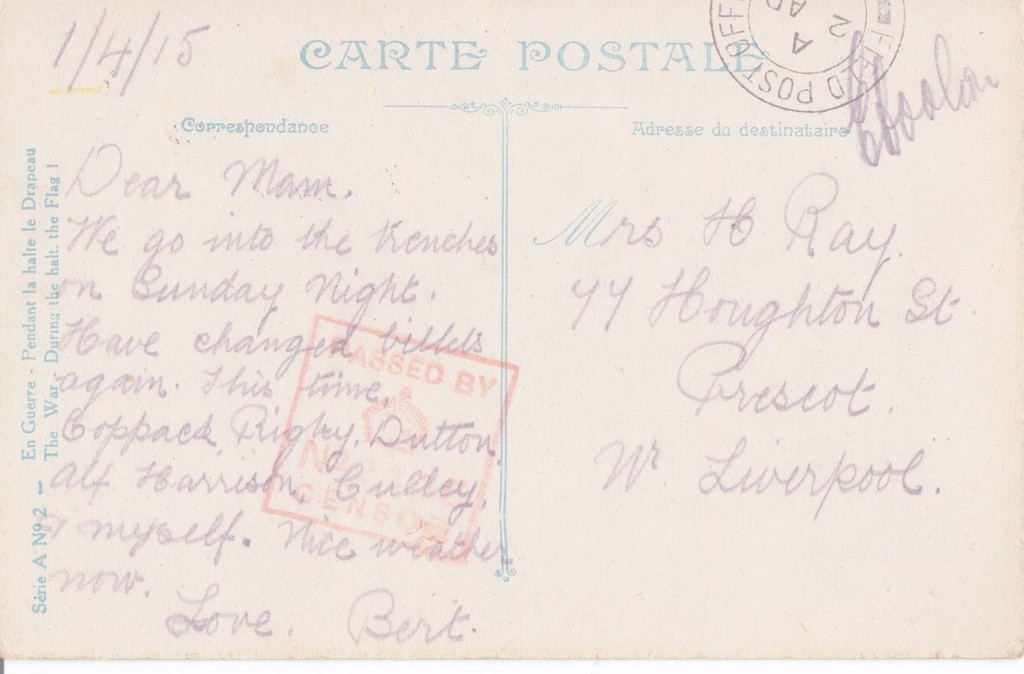
On 1st April 1915, Herbert wrote a postcra to his mother. It read,
"Dear Mam, We go into the trenches on Sunday night. Have changed billets again. Coppack, Rigby, Dutton, Alf Harrison, Culley & myself. Nice weather now. Love, Bert"
I am grateful to Sheila Anderson, Herbert's grand-daughter, who has allowed me to use the image below of the postcard.
On the day he wrote the card, the Battalion War Diary reported,
"April 1915
LE BIZET
During this month, the battalion held the same line of trenches as it had occupied during March. The line consisted of 1 company in the front line between CARTERS FARM and PACKENHAM FARM with 1 Coy in support. Supporting company placed 1 platoon in LYS FARM 1 at B BUTCHERS SHOP in support of PACKENHAM FARM. 1 platoon occupied trenches between RIVER LYS and CARTERS FARM by night only and 1 platoon as carrying and working party by night only.
1st April 1915
Draft of 54 rank and file arrived. 1 rifleman slightly wounded
"
I am also grateful to Kathy Donaldson for these transcriptions of letters from Sgt Ray which he sent home and which were published in the Prescot Reporter.
The Prescot Reporter 4th June 1915
GASES FOR THE 5TH
A WHIT- MONDAY EXPERIENCE
THE GRUMBLERS ARE FEW
How the men in the trenches become domesticated through having to supervise and prepare their own meals and look after their underclothing etc., is explained in a letter received from the Front to Mrs. E. J. Birchall of Hope Street, Prescot from Sergt Bert Ray of 'B' Company of the 5th:-
'Seven of us', he says, 'are sitting in a part of the reserve trench, and five of the seven are from Prescot. Joe Dutton, Peter Robinson, T. Byron (or Green) from the Market Place, Geo. Case and myself, Charlie Coppack and Harry Byron are a little further along. Well we are having a quite time during this spell in the trenches. The Germans gassed us on Whit-Monday, but we stuck it all right. The gas is terrible stuff, and makes the eyes sore, but it did not affect our breathing to any extent as we have been provided with special respirators. Our part of the line was not attacked, but we had to put up with plenty of artillery fire.'
Proceeding to describe the condition under which the men live he writes:-
'We are having very nice weather, which makes things far more pleasanter than they otherwise would be. We are not in billets now, but we are nearly always in some kind of trench, either 'firing line, 'reserve' or 'supports'. Dug outs are very scarce, so you will understand that wet weather makes us decidedly uncomfortable . We are not having a picnic, I can assure you. It is seldom we get an opportunity of washing ourselves, and I should say it is eight weeks since most of us changed our underclothing but we are not in the dumps. We make the best of things, and grumblers are few. When we drop back for a rest, and get into a barn or similar place we think as much about it as a 'Knut' having a night at the 'Adelphi'
The Prescot Reporter 11th June 1915
AT THE FRONT
A PRESCOT 'FIFTHS' DESCRIPTIVE ACCOUNT
WITH THE BATTALION DURING WHITSUN
THE EFFECT OF THE GAS
A stirring appeal from the trenches to the slackers and shirkers at home, is made by Sergt B Ray of the 5th South Lancashires who writes to his wife at 77, Houghton Street, Prescot. It proves how earnest are the men in the fighting line, and how strong is the determination to "stick it" whatever may be the consequences.
He commences his letter:-
'I really have had a busy time. You may guess when I tell you that I had a wash on Whit-Sunday and did not get another until this morning. How do you like that'
Continuing he writes:-
'Well, we are back from the firing line after a weary, but at the same time, quieter time. We are in the old farm house again, and hope to enjoy a good rest; we need it. One spell, I went without sleep for thirty hours. Dare not speak a word above a whisper as we are in close proximity to the Germans. I was out with a small party, and am pleased to say that we were congratulated on our work.'
THE LATE SERGT PLATT
'I had a great shock when I saw in the paper that poor Jack Platt had gone under. He will be missed out here, as well as at home. Jack was a good man with the maxim. Please convey to his mother my deepest sympathy. They are having a rough time with the guns, and Jack is dead, and Cleaver wounded, so they appointed men as sergeants in their places. One has since been killed, and the other wounded, so promotion is rapid in the maxim. Billy Naylor will be made gun-sergeant now. May he have better luck is my sincere wish. Their officer is Mr. Nesbitt, son of Mr. Nesbitt, of the Wireworks. He was formerly in charge of my platoon at Tunbridge Wells, and he came round the other day to see if I was all right, and said I was the battalion mascot. Hope I continue in the role.'
Referring to the death of Sergt Jack Yates , the writer states:-
'If you see Teddy Birchall please tell him that his brother-in-law Jack Yates was killed by a 'coal box' It knocked a part of our barricade in , and poor Jack was buried under the debris. He was dug out with all possible speed, but had sustained concussion. Capt Hammill will ask Canon Mitchell to break the sad news to his wife.'
TO PRESCOT LADS
First one and then the other of the Prescot boys are giving up their lives in defence of the old country. But I know this, we would rather be here doing our share than skulking at home, acting the coward's part. Sergt Jack Yates is honoured by his comrades. We, who were his friends, are losers by his death, and we would extend to his wife and children our deepest sympathy. I ask you to keep a good heart. Some of the boys will get through, and with the help of God I hope to be among them. You can take it from me the Prescot lads are doing a jolly good share of the work. Our ranks are thinning, and apparently we are not receiving any great help from our own chums. So far, we have only had three lads from Prescot in the drafts, but we hope this state of things will be remedied in the near future.
Writing later, Sergt Ray comments upon the experience of the men during a spell in the trenches when a thunderstorm arose and mingling with the terrific noise of the rifle and the fire from the big guns the scene created was an unforgettable one and according to Sergt Ray made a deep impression upon them.
'Our stay in the trenches,' he says 'was quieter by far than our previous experience in this locality. I thought we were in for it on the night we moved up. We were marching along and just before we reached the 'support trenches' a heavy thunderstorm broke over us. This would be about 11 p.m., and while the storm was on, a German attack took place against the French line. The noise was terrific. The crash of rifle and artillery fire produced an impression which will live with us for many a long year. The forces of nature seemed to be competing against the forces of man, and it would be hard to say which won. Anyhow the Germans did not.
WHIT WEEK IN THE TRENCHES
'We spent rather an uneventful day on Whit-Sunday. The storm had made the trenches in which we had to stay very wet, so that sleep was practically out of the question. Sunday, however was a beautiful day and the ground around quickly dried enabling us to sleep. Most of us would be satisfied if the rain keeps away.'
The first experience of the 'gas' is covered in the following terms:-
'Early on Whit-Monday morning we were roused by the sentries as the Germans took advantage of a favourable wind to gas our lines. This was the first taste for the 5th and I must admit we did not care for it. One or two of our men did not fit their respirators quickly enough, with the result that they had to receive medical attention. Properly and quickly applied the respirators are ample protection against the gas. The eyes suffer most. We are also provided with a veil arrangement. The battalion had to advance to support the firing line if needed and on our way we passed men who ere suffering from the latest German torture. One man in particular was reeling about the road, as if he were under the influence of drink. The German artillery shelled us heavily as we advanced, but we are getting used to shell fire, so they did not stop us.'
'Whit-Monday will be remembered by any man who took part (illegible) procession. It was a blazing hot day and rations were scarce. We could not light fires, so had to be content with water for a drink. During the day I had a piece of bread, a small piece of cheese, as biscuit and half a tin of condensed milk. Quite a feed! We stayed in the firing line till until Tuesday night, when we were relieved for a couple of days. We again took our turn in the front line on Thursday night and were not relieved until the Tuesday. However, the Germans did not trouble us much beyond shelling us occasionally. I wonder how people in England would like to go five days a hot meal or drink.'
A WELCOME CHANGE
'I was amused (continues the writer) when reading the 'Reporter' account of the display at Knowsley Park to see some people could not get tram nor train to take them home, and had to sleep out. They ought to be here, and see our selection of beds, best clay when in the trenches, best grass when out. After being relieved we marched to a rendezvous. It was just breaking day when we passed through a town which has been deserted for some time. The houses had been knocked about to some extent particularly in the neighbourhood of the church. This church is the only one I have seen which has not been damaged by German artillery. It was a fine building and looked well in the early morning light. Outside the main entrance was a life-sized representation of Christ on the Cross, and too many of our men it comes as a sign of hope. We entered the wood in which we were to rest just at dawn. Birds were singing, and the music and peaceful surroundings came as a wonderful relief to us after the noise of the guns. The men were dead beat. All we asked was a drink of tea and a rest. The tea was soon forthcoming and made us feel like new men. After a lounge we had breakfast then a wash. This was my first wash for ten days and I can tell you it was appreciated. Shortly afterwards we were again on the road, but a short march took us to our destination. The following day we were taken for a bath and received a change of underclothing. Just about ten weeks since we had had a bath and change.'
CONGRATULATED BY GENERAL COMMANDING
'Yesterday we were addressed by the General Commanding the 4th Division to which our battalion belongs. He complimented us on the way we had behaved in the trenches and assured us that our work out here was thoroughly appreciated. He hoped we would always remain under his command as he would not like to lose us.'
Concluding he writes 'The weather continues excellent and we are all in good fettle, brown as sand boys and just as happy'
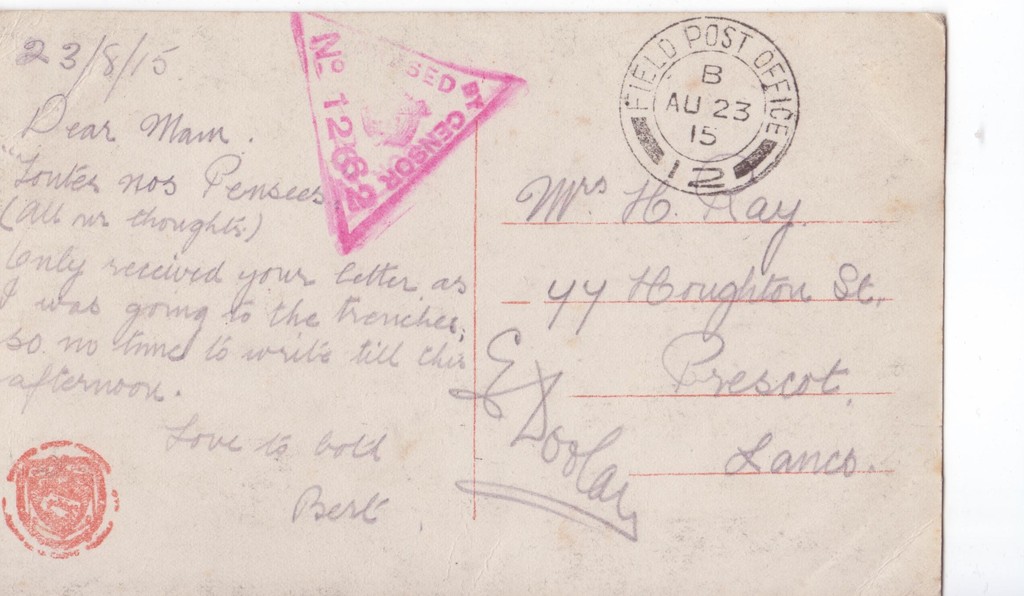
On 23rd August 1915, Herbert wrote another postcard to his mother (copy below again provided by Sheila Anderson)
"Dear Mam, 'Toutes les pensees' (All our thoughts).
Only received your letter as I was going to the trenches, so no time to write til this afternoon.
Love to both
Bert
"
The War Diary for that date reads,
"18th/19th August 1915
Relieved Essex Regt in same trenches East of Auchonvillers.
24th August 1915
Essex left 1 Coy in the village, a reserve coy. This company was relieved by a Company of the 2nd
Monmouth Regt.
"
The four pictures below were also provided by Sheila Anderson.
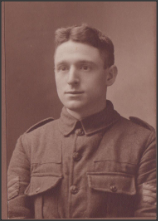
Herbert Ray in uniform
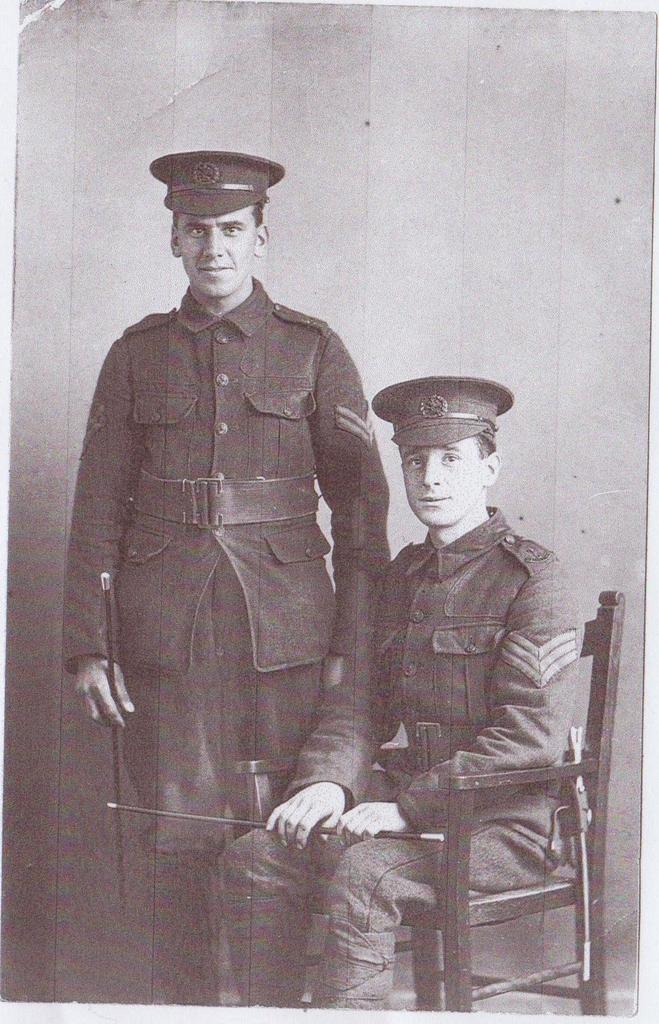
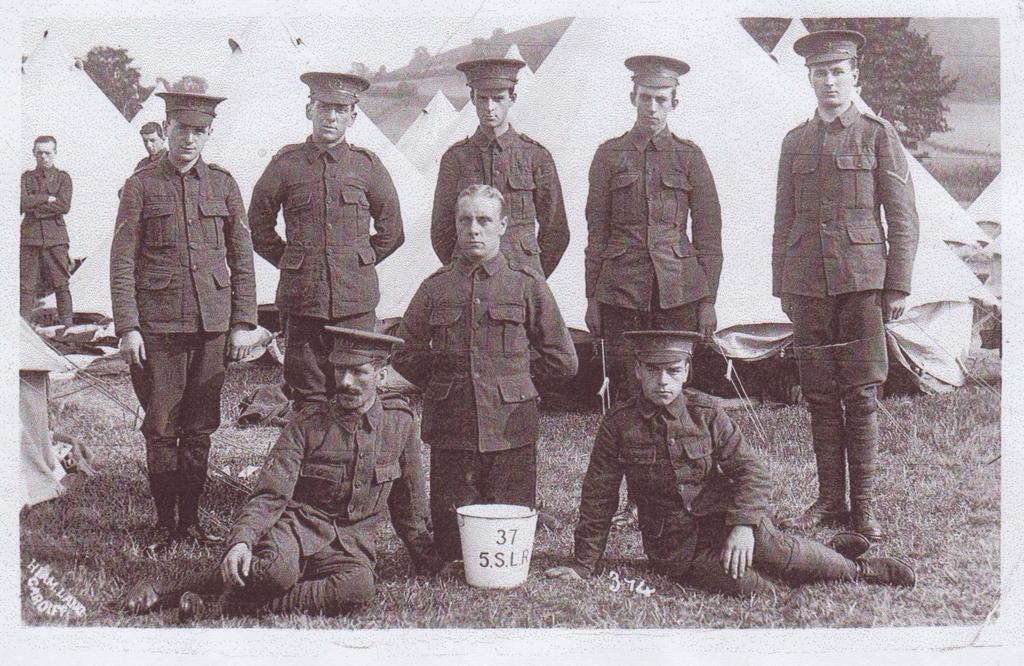
Sgt Ray (Seated) with an unknonn companion
Herbert is back left on this picture. He wears only a Corporal's stripe and it is likely that this picture is pre-war and was taken at an annual Territorial training camp
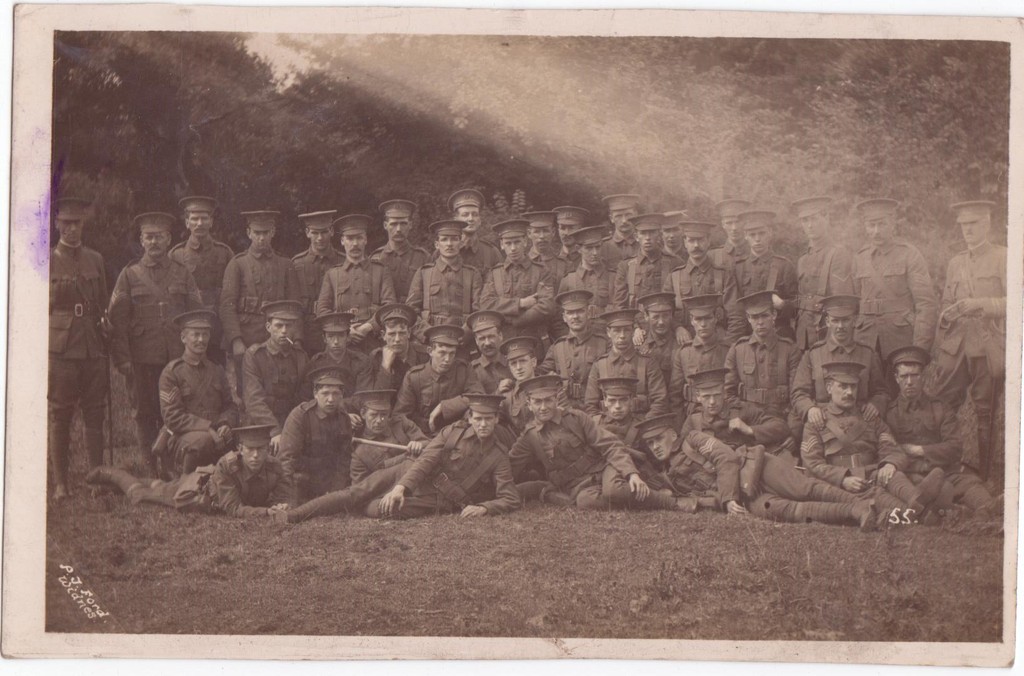
An undated group picture of some of the 5th Bn., South Lancashire Regiment
The regimental history of the South Lancashire Regiment reports that in April of 1916, Herbert was amongst the men who received the Distinguished Conduct Medal for gallantry under fire, and the London Gazette of 3rd June 1916 reported the award of the medal.
The citation read -
'For consistent good work and devotion to duty, notably when he volunteered for a double tour of duty at an isolated and dangerous post, which was awaiting an attack by the enemy.'
Herbert received his medal at the unveiling of Prescot Civic Memorial on 9th September 1916
Having served in the army for 10 years, Herbert returned to England on 1st April 1916 and was discharged on 4th April. His discharge papers show his next of kin was listed as Marion Ray of 77, Houghton Street, Prescot. He had originally written 'Adelaide Louise Dutton', but this had been crossed out.
Medal Index Card records his entitlement to the 1915 Star, British War Medal and Victory Medal.
Herbert died in Prescot in 1965, aged 76.
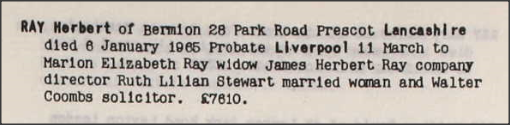
Herbert Ray's entry in the National Probate Register
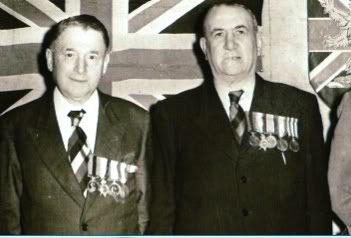
This picture, which was kindly provided by the family of William Moran. shows Herbert Ray on the left, with William Moran to the right. Both men had been awarded the DCM. It is assumed that the picture was taken at a regimental reunion, though the date is not known
Ref. No.:
|