WW1 Casualty: Sapper 156141 Robert Critchley - Sapper 156141 Robert Critchley

| Unit/Regiment |
182nd Tunnelling Coy., Corps of Royal Engineers |
| Date of Death |
20/04/1916 |
Age at Death |
36 |
Burial/Memorial
& Reference |
Menin Gate
Panel 6 and 8 |
| Census Details |
1901 Census -
Robert was 21 and a Colliery Carter. He lived at 2 Nuttall Street, St. Helens, with his father Thomas (66), mother Jane (50) and siblings Thomas (22), a Colliery Carter, Joseph (19), an iron worker, Edward (14), a bottle maker's apprentice, Henry (8), Margaret (10), Lillie (7), Beatrice (5) and Lucy (2). |
| SDGW - Where Born |
Prescot, Lancs |
| Enlisted |
St Helens, Lancs |
| Resided |
Haydock, Lancs |
| How Died |
Killed In Action |
Theatre of War |
France & Flanders |
| Notes |
Formerly G/11238 serving with 4th Royal Fusiliers. This is the entry which is held by CWGC |
| Research Ref. No. |
P065 |
Service DetailsThe pre-war British Army had no specific organisation for carrying out sapping, mining and tunnelling operations, although most men of the Royal Engineers received some training in the subject.
On 20th December 1914, ten small mines - each subsequently discovered to have been 50kg of explosive, driven under the British positions from saps in the German front-line system - were blown at Givenchy. An infantry attack followed, and over 800 men of the Indian Corps were lost. From that day, the constant threat of mining was one of the worst fears of the infantry.
On 3 December 1914, the CO of IV Corps, Sir Henry Rawlinson requested the establishment of a special battalion to assist with mining duties. The Armies were ordered to proceed with offensive mining operations using any suitable personnel they could find from within the ranks. These men were formed into Brigade Mining Sections
A decision was taken in February 1915 to form 8 Tunnelling Companies, made of men drawn from the ranks, mixed with drafts of men specially recruited for this kind of work. This has been described as the quickest intentional act in the war: men who were working underground as civilians in the UK on February 17th were underground at Givenchy only four days later! Such was the urgency of needing countermeasures against the aggressive German actions. Another 12 Companies were eventually formed in 1915, and one further one in 1916. As Robert Critchley was working as a Coal Miner at the time, he will have been one of the men immediately called upon to carry out the tunnelling work.
All of the Tunnelling Companies were engaged on underground work including the digging of subways, cable trenches, saps, chambers (for such things as signals and medical services), as well as offensive or defensive mining.
Once both sides had embarked on mining operations, there was a determined struggle for tactical superiority in those areas where conditions were favourable. At Hill 60, The Bluff, St Eloi, Aubers Ridge, Hooge, Givenchy and Cuinchy, where the front lines were relatively close together and the geology suitable for tunnelling, the mining companies sought ways to not only drive mines for destroying enemy positions, but developed measures of detection of the enemy mine systems. When detected, an enemy mine would be immediately destroyed by the explosion of a camouflet, often at the cost of severe damage to ones own system. There were many underground encounters, as one tunnelling team, breaking into an enemy position, met the enemy underground. Sometimes these encounters included fighting in the tunnels and chambers.
The 182nd Tunnelling Company Worked in positions near Bailleul in October 1915 before taking over the newly-begun Kruisstraat deep mines near Wytschaete. They then Moved to Armentieres and were relieved there in March 1916 by 1st Canadian. Spring 1916 saw a move to Berthonval and the construction of subways in Zouave Valley.
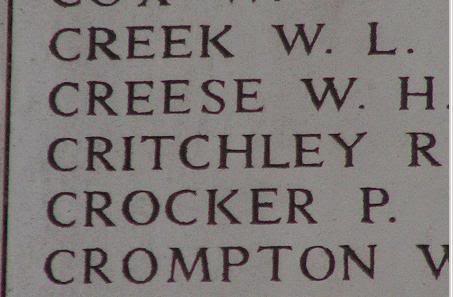
It is not clear where or how Sapper Critchley was killed. His body was either never recovered, or if recovered, was never identified and he is therefore remembered on the Menin Gate.
Robert Critchley's Medal Index Card shows service with the Royal Fusiliers as well as the Royal Engineers. He arrived in France on 6th July 1915 and was entitled to the 1914-1915 Star, British War Medal and Victory Medal
Sapper Critchley's inscription on the Menin Gate
Member Comments(0)
Please select a letter for a surname list:
|