WW1 Casualty: Private 2696 James Cowell - Private 2696 James Cowell

Prescot Reporter
| Unit/Regiment |
1st/5th Bn., South Lancashire Regiment |
| Date of Death |
24/05/1915 |
Age at Death |
30 |
Burial/Memorial
& Reference |
New Irish Farm Cemetery
III E 6 |
| CWGC Family Details (if shown) |
Husband of Mary Alice Cowell, of 1, No. 2 Court, Victoria Place, Prescot, Lancs. |
| Census Details |
1901 Census -
James, aged 15, was living at Derby Road, Huyton, with his widowed mother Ellen (45), and siblings Gareth (14), Margaret (1) and Sarah (9). |
| Birth/Marriage/Death Registrations |
Birth registered Q4/1884, Prescot, Vol 8b, Page 685
Marriage to Mary Alice Balmer registered in Prescot, Q1/1905, Vol 8b, Page 909 |
| SDGW - Where Born |
Huyton Quarry |
| Enlisted |
Prescot |
| How Died |
Killed In Action |
Theatre of War |
France & Flanders |
| Research Ref. No. |
P061 |
Service DetailsJames Cowell was born in Huyton Quarry in 1884, the son of James, a farm labourer, and Ellen Cowell. He was one of 8 children.
He married Mary Alice Balmer, a Watch Maker from Victoria Place, Prescot, on March 25th 1905 at the Workhouse in Whiston. The marriage had been witnessed by Ellen Cowell and Alfred Cowell. They went on to have four children; Alfred, born June 9th 1905, John, born April 29th 1907, William, born January 7th, 1910 and Martha, born September 20th, 1913.
James Cowell attested into the army on 9th September 1914 for the duration of the war. He noted that he had been born in Huyton Quarry, was 30 years old and that he worked as a labourer.
His records show that he was 5foot 5 inches tall and weighed 10stones with a 38 inch chest, expanded to 40 inches. He had a fresh complexion, grey eyes, and light brown hair. His religion was Church of England.
On 7th December 1914 at Blackpool, Private Cowell again underwent a medical. This further noted that he had received vaccinations in childhood. As a result of this medical, he was assigned to the 5th (Reserve) Battalion of the South Lancashire Regiment.
The 5th Battalion, South Lancashire Regiment, had just started its annual training in camp when war broke out in August 1914. It was sent to Edinburgh until October, then moved to Tunbridge Wells until February 1915. It was then ordered to France, sailing on the 13th aboard s.s. King Edward., arriving at Le Havre the same day.
Over the next few days the battalion marched to billets at Le Bizet, and then undertook instruction in trench warfare. The system was for companies from a battalion to be attached to other battalions for spells in the line, before the sector was allocated to the battalion on its own. In addition to the trench duty, the battalion undertook its share of pioneer work and training in rapid fire.
The Battalion was moved around regularly without seeing action, until 28th April when it was moved to Vlamertinghe, Belgium in readiness to take part in the 1st Battle of Ypres, which had started on the 22nd.
On 2nd May, the Germans launched a violent attack, accompanied by a cloud of chlorine gas, and the battalion was moved into the line for the first time. On 3rd May, it was moved to the new line in front of Wieltje, and then on the 4th it was again moved to Shell Trap Farm. At dawn, they engaged the Germans but by 4pm the enemy was within 400 yards of the British lines, from where they began a heavy bombardment of the British lines.
More shell fire continued through the next day, culminating in heavy concentrated fire about 5 p.m. which resulted in a considerable number of men being buried, many of them killed and wounded. The enemy fire continued until midnight and four attempts were made by the Germans to take the farm, but all were repulsed.
At 2 a.m. on the 6th, the Battalion was relieved and moved to La Brique, having incurred considerable casualties.
On the 8th May, the battalion was once more sent up to the Wieltje sector as it was thought that the enemy had broken through, but it proved to be a false alarm and on the 9th it returned to La Brique, leaving 'C' Company and a machine-gun detachment at Wieltje. Early on the 10th, the battalion moved to the bank of the Yser canal where it remained until the 13th, when it was moved back to the support lines.
It was more of the same throughout the next two weeks of May, then at 3 a.m. on the morning of the 24th, the Germans released the largest cloud of gas seen so far in the war across a wide stretch of the British lines, followed by a large assault force. Their followed almost a full day's desperate fighting, often in very confusing situations, 'B' and 'C' companies occupied French Switch, a trench connecting the British and French troops, but they suffered from very heavy shelling of the trench, which inflicted considerable casualties.
The remainder of the day and all of the 24th was spent in reorganisation and consolidation, also re-establishing contact with the French. The battalion remained in the front line until 1st June, but no serious German attacks were launched after 25th May, although small scale actions continued. Both sides were now exhausted, having been in almost continuous contact for 33 days.
A Casualty Form dated 4th June 1915, reports that James Cowell was wounded, suffered Gas Poisoning and was reported missing as a result of action in the field.
A War Office letter of 8th February 1916 stated that Mrs. Cowell had been awarded a pension of 22/6 (22 shillings and 6 pence) per week in respect of Private Cowell, noting that they had four children.
The War Office wrote to the Army Records Office on 24th June 1916 to say that for official purposes, Private Cowell was to be regarded as 'having died on or since 24th May 1915' and that the next of kin should be advised accordingly. It seems likely that the casualty form reporting him wounded and dated 4th June 1915 was completed when the action was over and information was being collated on killed, wounded and missing men.
On 1st September 1916, the War Office further instructed the Army Records Office that any personal effects of Private Cowell should be forwarded to his wife, Mrs. Mary A. Cowell, of 7, Victoria Place, Prescot.
The Army Records Officer wrote to Mrs. Cowell on 10th July 1919, stating that according to their records, she was Private Cowell's next-of-kin and as such, would be entitled to the memorial plaque and scroll issued to the family of all deceased soldiers, and asking her to confirm this fact. She replied to confirm her name as 'Mary Alice Cowell' and her address as 'No 1 House, No 2 Court, Victoria Place, Prescot'.
Mrs. Cowell wrote to acknowledge recipe of Private Cowell's British War Medal and Victory Medal on 20th September 1921.
On December 16th 1923, Mrs. Cowell acknowledged receipt of '1 disc', this being the property of her late husband which had been forwarded on to her. As Private Cowell had been reported missing 8 years earlier, it seems likely that his body had been found and identified as part of the post-war battlefield clearances. The only effects on the body were the disk, which enabled the body to be identified and resulted in Private Cowell being buried in New Irish Farm Cemetery.
At the time of the Armistice in November 1918, the cemetery had contained just 73 burials but was greatly enlarged when over 4,500 graves were brought in from the battlefields north-east of Ypres and from other smaller cemeteries in the area, as well as bodies found in the clearances. Over 3,200 of the burials are unidentified.
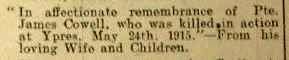
Prescot Reporter 14th September 1917
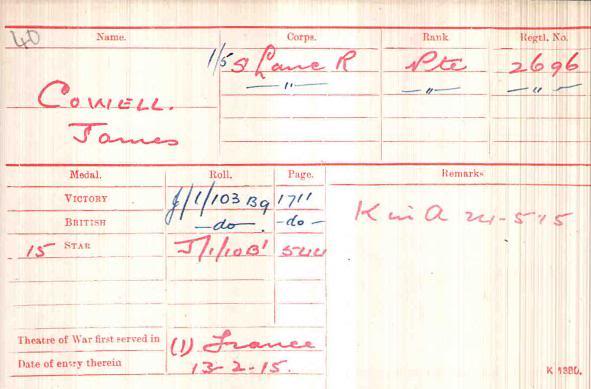
James Cowell's medal Index Card shows his arrival in France on 13th February 1915, and his death just three months later. He was entitled to the 1914-1915 Star, British War Medal and Victory Medal
James Cowell's grave at New Irish Farm Cemetery
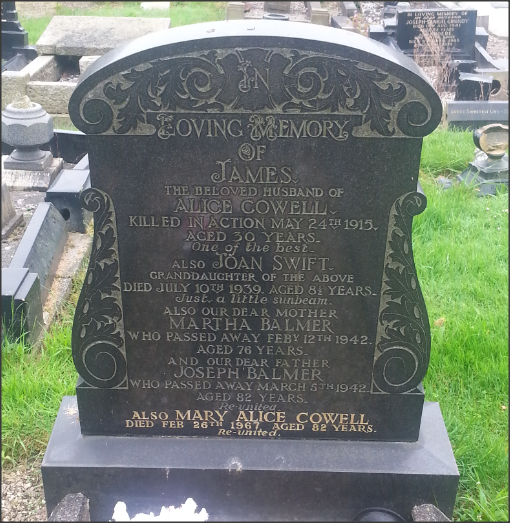
James Cowell is also remembered on this family headstone in Prescot Cemetery. Picture courtesy of Les Birchall
Member Comments(0)
Please select a letter for a surname list:
|