WW1 Casualty: Lance Sergeant 241194 Richard Carney - Lance Sergeant 241194 Richard Carney

| Unit/Regiment |
2nd/5th Bn., South Lancashire Regiment |
| Date of Death |
02/01/1918 |
Age at Death |
22 |
Burial/Memorial
& Reference |
Dozinghem Military Cemetery
XV H 6 |
| CWGC Family Details (if shown) |
CWGC records his next of kin as Mr W Carney of 23, William Street, Prescot |
| Census Details |
1901 Census -
Richard was living at 26 Fox Street, St Helens, with his parents Patrick, a 28 year old chemical labourer, Mary (24) and siblings James (10), John (8), and Alice (2)
1911 Census -
15 year old Richard was a Glassworker's Labourer living at 154 College Street, St Helens, the home of his adoptive parents, John and Johanna Firlong |
| Birth/Marriage/Death Registrations |
Birth Registered Q4/1895, Prescot, 8b, 735 |
| SDGW - Where Born |
St Helens |
| Enlisted |
Prescot |
| Resided |
Prescot |
| How Died |
Died of Wounds |
Theatre of War |
France & Flanders |
| Research Ref. No. |
P041 |
Service DetailsThe 2nd/5th battalion of the South Lancashire regiment was officially constituted at Liverpool on September 23rd, 1914, principally as a 'second line' unit for the 1st/5th battalion. It proceeded to Blackpool on 11th November to commence its training, although it was severely handicapped in the early days by a lack of uniforms and equipment.
Early in 1915, the battalion was moved to Tunbridge Wells in Kent, forming part of the Central Force for Home Defence, although training was still hampered by the lack of equipment. The battalion consisted of 37 officers and 1,203 other ranks, although a significant proportion of these were for Home Service only. In addition, a high turnover of personnel came about due to the large number of discharges on medical grounds.
In May of 1915, the first draft to replace casualties at the front was called for and 10 officers left immediately for France. A steady drain of men continued until November, when the 3rd/5th battalion was formed to act as a Dept for men who had been evacuated due to wounds or sickness, also supplying drafts to the first line battalion. The second line battalion was now able to form itself into a shape fir for the purpose of fighting.
As 1916 progressed, the battalion remained on Home Service, mainly constructing field fortifications for the protection of London, south of the Thames. In June, however, the battalion was moved to Ashdown in Kent to complete training in preparation for moving overseas. Orders were not received until Christmas 1916, however. Eventually, the battalion entrained at Farnborough on 16th February 1917 for Folkstone. Their departure for France was delayed by fog until the 20th, when they sailed on the s.s. 'Princess Henriette' with a full complement of officers and men.
Their early days in France were mobile, moving from Boulogne to Bailleul, then Oultersteene and finally to Armentieres. Here on 4th March, they moved into the front line trenches for the first time, relieving the men of the 2nd/4th battalion. At this time, Armentieres was a 'quiet' sector and so the battalion passed the month of March suffering few casualties.
The battalion moved constantly around the front line areas throughout the remaining months of the year, ultimately moving into front line trenches in the Houthulst Forest sector on Christmas Day under constant German harassing fire. On 27thn of December, 'B' and 'C' companies were relived in preparation for a raid on Turenne Crossing, north of Poelcapelle. They went back to Baboon Camp for training for the assault, planned for the night of 30th/31st December. The operation had been carefully rehearsed and was scheduled to start at 8 p.m., supported by artillery, machine guns and mortars. Snow was lying thickly and the raiders were instructed to wear white shirts over their uniform.
The companies advanced at zero hour under a creeping barrage. The artillery was effective and little resistance was encountered, with all the objectives being taken and the line being advanced by 200 yards. However casualties were suffered with 2 officers and 17 other ranks killed and 13 wounded.
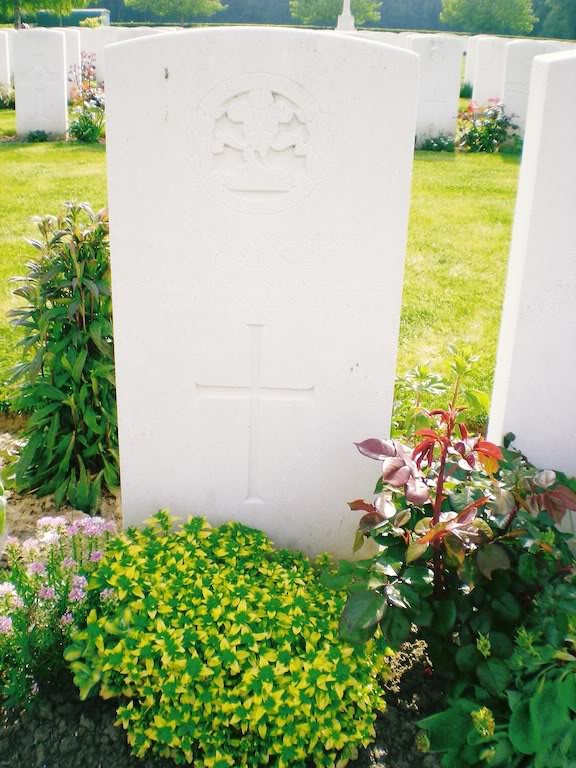
Sergeant Richard Carney was one of the wounded. He succumbed to his wounds on 2nd January 1918 and now rests in Dozinghem Military Cemetery.
The Parish Magazine of 26th January 1918 reported the death as follows: 'Sergeant Richard Carney, 21, of the S. Lancashires who was killed 2nd January 1918, of 23 William Street'.
Richard Carney's Medal Index Card, above, lists his entitlement to the British War Medal and Victory Medal
Richard Carney's grave at Dozinghem Military Cemetery
Picture (c) George Simpson
Member Comments(0)
Please select a letter for a surname list:
|