WW1 Casualty: Second Lieutenant Henry Byron - Second Lieutenant Henry Byron
© Prescot Reporter
| Unit/Regiment |
1st/5th Bn., South Lancashire Regiment |
| Date of Death |
08/09/1916 |
Age at Death |
22 |
Burial/Memorial
& Reference |
Dartmoor Cemetery, Becordel-Becourt
I A 19 |
| CWGC Family Details (if shown) |
Son of George and Annie Byron, of 26, Baker St., Kensington, Liverpool. Native of Prescot, Lancs |
| Census Details |
1901 Census -
George Byron (37, a Joiner ) and his wife Annie (30), lived at 2, Rook Cottage, Eccleston Lane Ends with their children Henry (7), Bessie (4), Alee (2) and Sydney (11 months)
1911 Census -
35, Cross Street, Prescot, was the home of 47 year old George Byron, a Journeyman Joiner at the Wire Works, his wife of 20 years, Annie, and their children Harry (17), a Joiner's Apprentice, Bessie (14), Alec (12), Sidney (10), William (7) and Elizabeth (3). |
| Birth/Marriage/Death Registrations |
Birth registered Q1/1894, Prescot, Vol 8b, Page 694 |
| How Died |
Died of Wounds |
Theatre of War |
France & Flanders |
| Research Ref. No. |
P033 |
Service DetailsThe October 1915 Parish Magazine included the following entry:-
"IT IS VERY GRATIFYING TO HEAR that four N.C.O.'s of the 5th South Lancashires, in France, have had their services recognised by being promoted to Second Lieutenants. Among these is Harry Byron, of Cross Street, Prescot, whom we congratulate on his well-deserved honour. "
(Item courtesy of Les Birchall)
Although the Battle of the Somme had commenced on 1st July 1916, the battalion, part of 55th Division, was only engaged with active patrolling and sniping. On 22nd July, they received orders to move south and on the 25th, they arrived at billets inn Ville-sous-Corbie.
On 8th August, the battalion was ordered to capture the village of Guillemont, which had defied all previous attempts at capture and was a thorn in the side of the British forces. The attack commenced at 4.20 a.m. and initially all objectives were taken despite strong resistance. By the end of the day, the Railway Station and the front line trenches in front of the village were in allied hands. Orders were then received to be ready to continue the attack the following morning.
Zero hour was again at 4.20 a.m. and the initial assault was met with withering machine gun fire from the German defenders, resulting in the troops falling back to their starting points. This also resulted in the companies being heavily mixed up and it was noon before reorganisation was complete. After this, the battalion remained near Trones Wood until the 10th, clearing the dead of the previous two days of battle and consolidating the ground won at such a heavy cost. On the evening of the 10th, they were withdrawn to bivouac and then on the 12th returned to the line at Maltz Horn Farm.
On the 13th, 'D' Company of the battalion worked in partnership with French units to clear German forces from an area known as Cochrane Alley, specifically to take an isolated German trench. Unfortunately the French failed to take their objectives and the British attack came under withering German machine gun fire which drove the men back. The battalion was withdrawn on the 15th, this time to billets at Meulte. In three days of fighting they had lost 3 officers and 80 other ranks - slight losses in comparison to other units at that time.
They remained out of the line until 5th September when they were sent to occupy support trenches in front of Delville Wood. This was a notoriously 'unhealthy' place to be at that time and the battalion was kept busy digging strong points and communications trenches, usually under heavy enemy artillery fire.
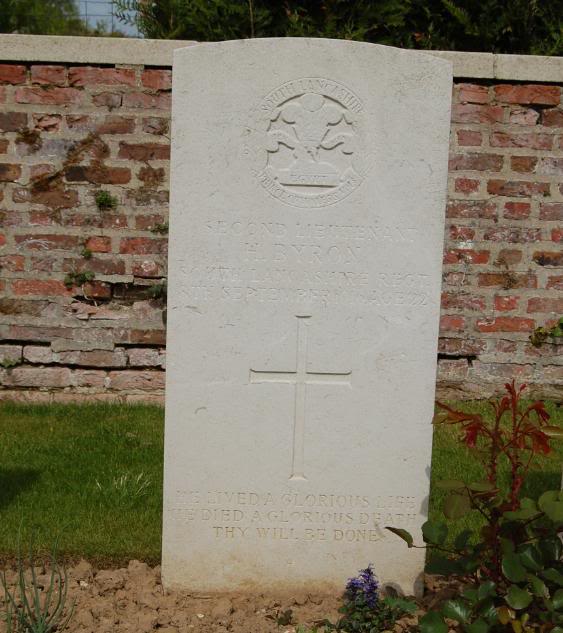
Harry Byron died on 8th September of wounds received in one of the earlier actions. He rests in Dartmoor Cemetery.
The Battalion War Diary for the period in which he died is reproduced below.
Sept 7
Btn out at night digging Strong Points 300' in advance of front line trenches held by 1/5 Loyal North Lancs Regt. Four Strong Points dug and Communication Trench from original front line to Right Strong Point. Casualties 4 Officers 40 O Ranks.
Sept 8
Strong Points were garrisoned by 1 Officer and 20 O.R. and Communication Trench held by 2 Officers and 60 O.R. About 10am an enemy 5.9 Battery heavily enfiladed near Communication Trench and badly damaged it. During the night Strong Points were completed and connected up under very accurate sniping fire in spite of this work was well done and fully completed. Casualties 4 Officers 45 O.R.
Sept 9
Shortly after his death, the Prescot Reporter carried the following item:-
LOCAL OFFICER DIES OF WOUNDS
Great regret will be expressed in this district at the news that Second-Lieutenant Harry Byron of the South Lancs, died of wounds on Friday last.
Lieut. Byron, who lived at , Cross Street, Prescot, was only about 22 years of age. He joined the South Lancs Regiment as Rifleman when 15 years of age and on the outbreak of war was promoted from Corporal to Sergeant. Out at the front, his conduct was so meritorious that he was eventually given a commission and his death will be regretted very much among his comrades, by who he was greatly esteemed.
Lieut. Byron attended the classes at the Gamble Institute for a number of years and gained the first class certificates for carpentry and joinery. He was a good shot, and held the battalion's cup for marksmanship."
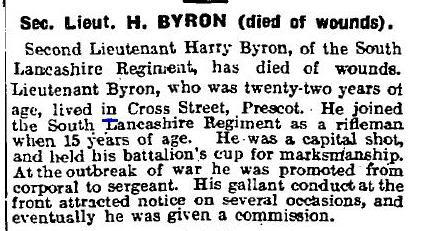
Harry Byron's death announcement in the Manchester Guardian dated 14th September 1916
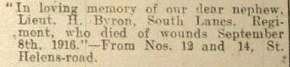
From the Prescot Reporter, 14th September 1917
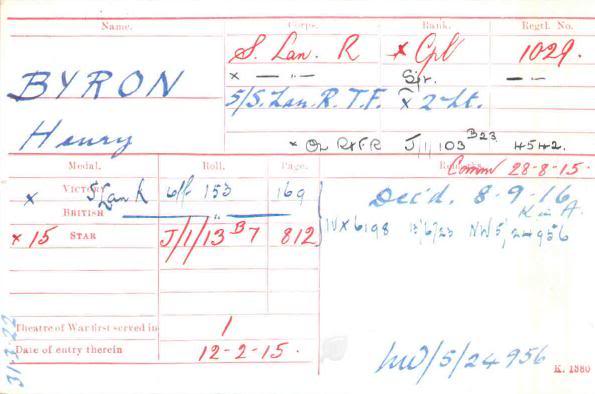
Henry Byron's Medal Index Card shows his progression from Corporal to Sergeant and then onwards to Second Lieutenant
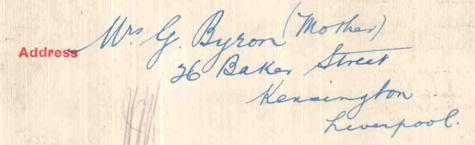
Harry Byron's mother was shown on the reverse of his Medal Index Card to be living in Kensington, Liverpool, when his medals were issued.
Henry Byron's grave at Dartmoor Cemetery
Member Comments(0)
Please select a letter for a surname list:
|