WW1 Casualty: Private 29882 William Henry Prescott - Private 29882 William Henry Prescott

| Unit/Regiment |
7th Bn., South Lancashire Regiment |
| Date of Death |
22/07/1917 |
Age at Death |
27 |
Burial/Memorial
& Reference |
Menin Gate
Panel 37 |
| CWGC Family Details (if shown) |
Son of John Edward and Sarah Ann Prescott, of 36, Stapley Rd., Belvedere, Kent; husband of the late Elizabeth Alice Prescott, of 76, Eccleston St., Prescot, Lancs. |
| Census Details |
1901 Census -
William Henry Prescott is shown on the census as "Henry", aged 10, and is living with his parents John (51, a Blacksmith) and Sarah (41) living at 3, Stapley Road, Erith, Kent. Also there are his siblings Ellen (21), Ethel (15), John (12) and Frank (4)
1911 Census -
The family still lived in Belvedere, Kent. 20 year old William was employed as a General Labourer at the Electric Light Works. |
| Birth/Marriage/Death Registrations |
Birth Registered Q4/1890, Dartford, Vol 2a, Page 438 |
| SDGW - Where Born |
Belvedere, Kent |
| Enlisted |
Bexley Heath, Kent |
| Resided |
Prescot |
| How Died |
Killed in Action |
Theatre of War |
France & Flanders |
| Research Ref. No. |
P229 |
Service DetailsThe 7th (Service) Battalion was formed from the large number of recruits who flocked to the colours as a result of Kitchener's appeal in August 1914. The 6th and 7th Battalions were formed within a few days of each other but the 7th did not receive any uniforms until October, having to wear civilian clothes up to that time.
It was eventually trained and fully equipped by March 1915 and on 17th July the battalion embarked fro France on the SS 'Onward', arriving at Bolougne.
They moved into the line for the first time on 28th August, in the Festubert-Givenchy sector. They moved in and out of the line in rotation for several months, enduring the daily grind of warfare, with trench raids, artillery attacks, etc. to contend with.
In June 1916, the battalion was ready to join the great Somme offensive. On the 1st July, they moved into the line at 9.30, some 3 hours after the start of the assault, and waited for instructions. They were moved around for the next two days, but did not as yet engage the enemy. On 3rd July, they were tasked with an attack on the strongly defended ruins of La Boisselle, although the start time for the attack was not until 9.30 p.m. The attack was fierce and sustained extremely heavy casualties, but the village was finally cleared by bayonet point at 3pm the following day.
The battalion was withdrawn from the line early on 6th July, moving back to rest billets at Albert.
They moved in and out of the line throughout July as the battle of the Somme wore on, until finally at the beginning of August, they moved northwards into Flanders, to the Messines Ridge. They moved on again in September to the vicinity of Ploegsteert but spent a relatively quiet time there before yet again returning to the Somme in October, although the time was uneventful with regard to major incidents.
The battalion moved around the various fronts over the following year, being constantly engaged in many of the major operations, culminating in the Battle of Messines in June 1917.
In early July of that year, they moved to Butterfly Farm Camp and presented themselves to The King on one of his tours of the battlefield. They trained and refitted until the 19th when they once more went back into the line, near Pheasant Wood.
On 22nd July, 'A' Company was tasked with capturing a tactical locality known as 'Junction Buildings', close to Oostaverne. These buildings had been captured twice already but on each occasion had been subsequently lost to German counter attacks. The attack began at 7.00 pm when the men swept forward under cover of the barrage and the objective was soon taken. At 9.00 pm, a message was received by carrier pigeon to say that a counter attack was in progress and asking for reinforcements, but Brigade Headquarters felt that it was impossible to consolidate the ground won. Subsequently, the company was relieved later that evening. All of the officers had been hit and of the 128 men who went into action, 55 were killed or wounded before the withdrawal.
Amongst those killed was Pte. William Prescott. He has no known grave and is remembered on the Menin Gate Memorial to the missing.
The Parish Magazine of 25th May 1918 added 10 names to the existing 106 who had already fallen, including 'Pte. William Henry Prescott, 27, 7th South Lancs. Missing since 22nd July 1917 and now believed by the War Office to have been killed. He leaves a widow and a baby boy, of 76, Eccleston Street'.
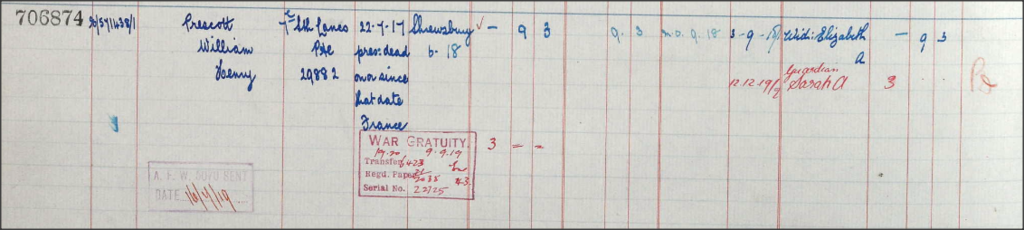
The Register of Soldiers Effects, noting that William was presumed dead
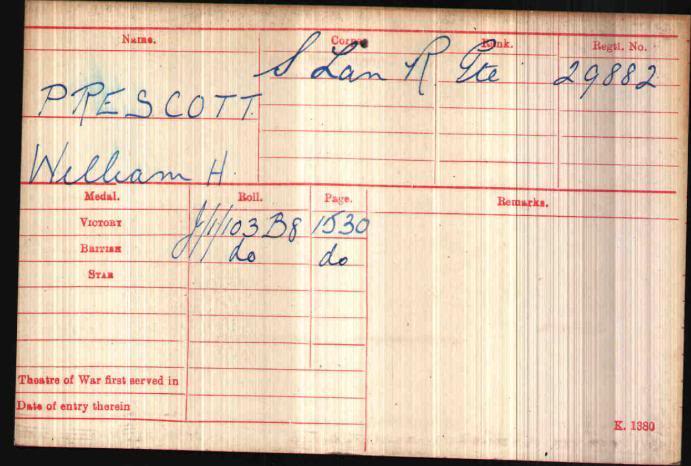
William Prescott's Medal Index Card
William Prescott's inscription on the Menin Gate
Member Comments(0)
Please select a letter for a surname list:
|