WW1 Casualty: Private 21939 Alfred Taylor - Private 21939 Alfred Taylor

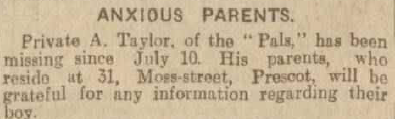
Prescot Reporter 28/07/1916
| Unit/Regiment |
17th Bn., King's (Liverpool Regiment) |
| Date of Death |
10/07/1916 |
Age at Death |
21 |
Burial/Memorial
& Reference |
London Cemetery and Extension, Longueval
4 F 28 |
| CWGC Family Details (if shown) |
Son of the late John and Hannah Taylor; brother of Herbert Taylor, of 21. Liverpool Rd., Prescot, Lancashire.
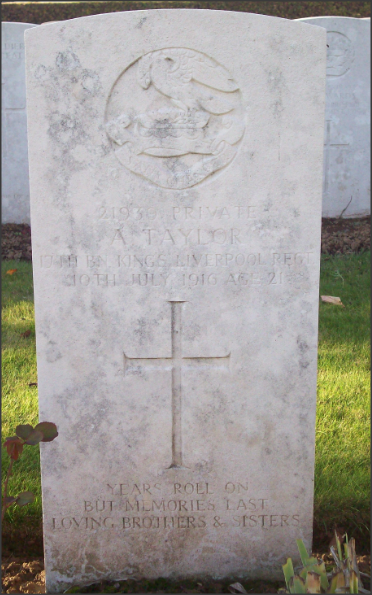
CWGC Headstone Inscription -
YEARS ROLL ON
BUT MEMORIES LAST
LOViNG BROTHERS AND SISTERS |
| Census Details |
1901 Census -
The family were living at 4, Rimmers Road, Eccleston. Father John (48), mother Hannah (47) and children Herbert (20), Thomas (18), Alice (16), Isaac (12), Hannah (9), Emma (7) and Alfred (5).
1911 Census - The Taylor family lived at 31, Moss Street. Alfred was 14 and worked as an Office Boy in the General Office of the Wire Works |
| SDGW - Where Born |
Prescot, Lancs |
| Enlisted |
Prescot, Lancs |
| Resided |
Prescot, Lancs |
| How Died |
Killed In Action |
Theatre of War |
France & Flanders |
| Research Ref. No. |
P272 |
Service DetailsAlfred Taylor enlisted in November 1914, giving his address as 31, Moss Street, Prescot. His next of kin was recorded as his father, John, at the same address.
The 1914 Electoral Roll entryt for Alfred's father, John Taylor
The 17th (Service) Battalion of the King's (Liverpool Regiment) has the distinction of being the first of the 'Pals' battalions formed during the war. The battalion was raised by Lord Derby on 29th August 1914 in the Prescot Watch Factory. The battalion was also referred to as the 1st City Pals battalion.
He embarked for France on 7th November 1915 and served as a Company Runner.
As part of the Somme offensive, the 17th battalion were responsible for the capture of Montauban (popularly known to the troops as 'Montybong'). Under the command of Lt. Col. B. C. Fairfax, they moved up to their assembly trenches by 3.30 a.m. on the morning of 1st July, these being on a frontage of the Maricourt-Briquerie road. A French battalion was on their right and the 20th (King's) was on their left. The German lines were between 200 and 400 yards ahead.
The attack commenced at 7.30 with a swarm of men going 'over the top'. It is worthy of note that this was the first time that the new steel helmets had been worn. The battalion advanced quickly across 'No Mans Land' with very little resistance and they quickly took their first objective, known as 'Dublin Trench' by 8.30, the allotted time, and then dug in. The battalion suffered casualties of 3 officers wounded and 100 other ranks killed and wounded.
The 17th Battalion spent the remainder of the 1st July, and the whole of 2nd July, in consolidating their captured Dublin and Casement trenches, with two companies of the battalion in each, and in digging a communications trench between them. The battalion also reported the 3rd July as a 'quiet day', although German shelling continued.
One of the most difficult points to take on the Somme front was Trones Wood. By 10th July, four attacks had already been launched against the wood in an attempt to capture the whole of it, but no more than a foothold had been obtained in the southern end of the wood.
One company of the 17th Battalion had launched an attack against a German post situated where Trones Alley entered the wood, but the attack was a failure and the Battalion suffered heavy casualties. Private Taylor is likely to have been one of the casualties of this action.
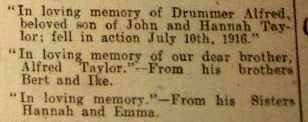
A Family announcement in the Liverpool Echo on 7th August 1916
The Parish Magazine of 22nd July 1916 reported "Four more of our townsmen have been reported Killed in Action", and included 'Pte. Alfred Taylor of Moss Street, who was bugler to the 1st Liverpool Pals Battalion'.
His service is commemorated on the United Reformed Church Roll of Honour
On 28th July 1916, the 'Prescot Reporter' stated 'Runner Alfred Taylor, the son of Mr. John Taylor who resides at 31, Moss Street, Prescot, has been reported 'missing' but fears are entertained that a more serious fate has overtaken him.
Lieutenant Williams of the King's (Liverpool) Regiment, writing on Friday, said that although Taylor had been reported missing, they were certain that he had been killed. He was one of the company's runners and had rendered excellent and invaluable work. He had carried several messages and had returned with the answers and in every way he had proved himself highly plucky. He was, therefore, a great loss to the company. The young fellow, for whom deep and gravest fears are entertained, was only 20 years of age. He was a great favourite among his friends at Prescot, and admired by all with whom he came in contact.'
Prescot Reporter 14th September 1917.
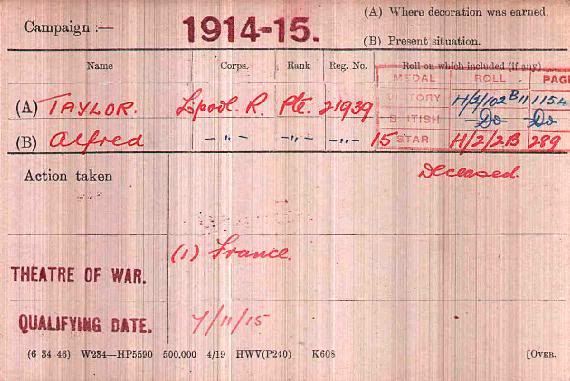
Alfred Taylor's Medal Index Card. He was entitled to the 1915 Star, British War Medal and Victory Medal
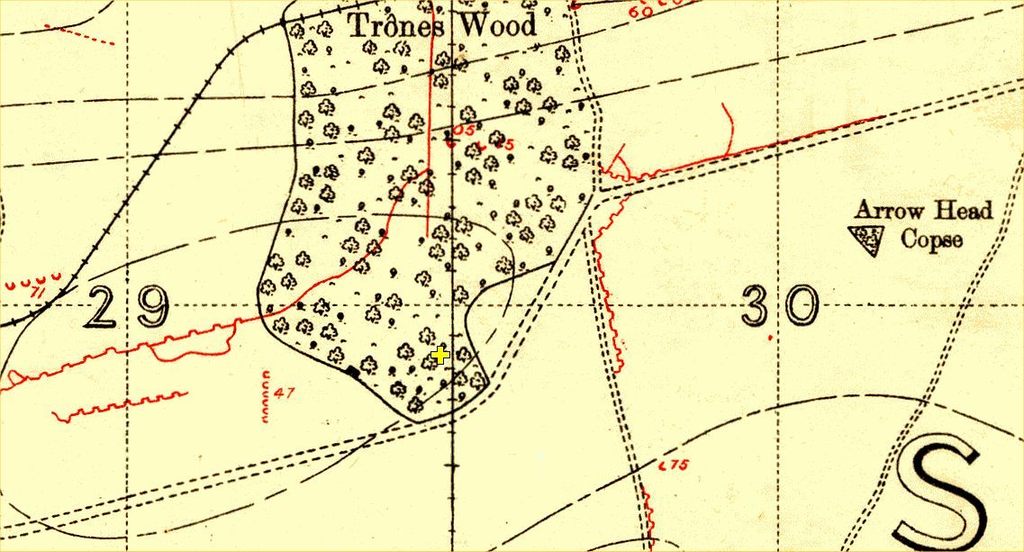
The map above shows Trones Wood, with a yellow "plus" sign noting the point where Alfred's body was found
The exercise to find and identify soldiers killed in the war continued for many years, and it was not until 1935 that Alfred's body was found. The image below shows that he was identified by his ID disc, and he was then buried in London Cemetery.
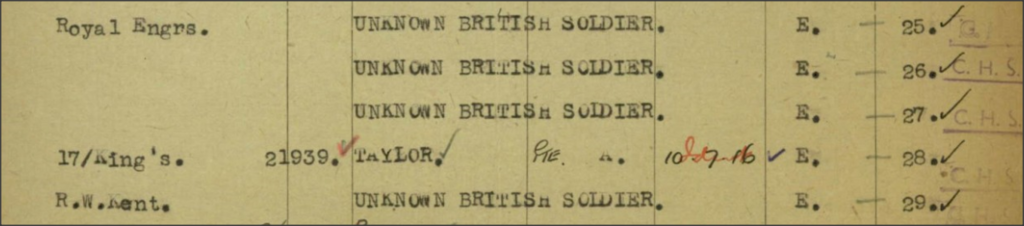
The Commonwealth War Graves report shows that Alfred is buried amongst a group of unidentified soldiers
In the 1920's, the Taylor family were sent a "Final Verification Form" by the Imperial War Graves Commission, on which they were asked to confirm Alfred's details and also to state the inscription which they wished to have on his headstone.
The form was completed and returned, though subsequently changes were made to the personal inscription.
The final form is shown below.
Pte Taylor's headstone, courtesy of Tony Wainwright
Member Comments(0)
Please select a letter for a surname list:
|