WW1 Casualty: Apprentice Harry Reginald Vercoe - Apprentice Harry Reginald Vercoe

| Unit/Regiment |
SS Kendall Castle (Liverpool), Mercantile Marine |
| Date of Death |
15/09/1918 |
Age at Death |
19 |
| Burial/Memorial |
Tower Hill Memorial |
| CWGC Family Details (if shown) |
Son of John Lean Vercoe, of "Caldbeck," Eccleston Park, Prescot, Lancs. Born at St. Helens |
| Census Details |
1901 Census -
The family lived at 69 Church Street, St Helens and comprised John Vercoe, 34, a Medical Dispenser, his wife Annie (30) and 1 year old Harry.
1911 Census -
The family lived in Eccleston Park, where Harry (Henry) was listed as an 11 year old Schoolboy
|
| Birth/Marriage/Death Registrations |
Birth Registered Q2/1899, Prescot, 8b, 771 |
| Notes |
KENDAL CASTLE was torpedoed without warning and sunk by the German submarine UB-103 four miles S.E. of Berry Head on September 15th 1918. Casualties were 18 including the master. She was built in 1910, a 3,885 gross tons steamship owned by the Lancashire Shipping Co. Managed by James Cambers & Co., Liverpool, she was enroute from Le Havre to Cardiff in ballast. The sinking of Kendal Castle has recently been reassessed and credited to UB 104. See below for more details.
The name of Harry Vercoe is included on the memorial at Christ Church in Eccleston. |
| Research Ref. No. |
P282 |
Service DetailsHarry Reginald Vercoe was a pupil at Prescot Grammar School from 1906 to 1914. His service is commemorated on the Grammar School Roll of Honour
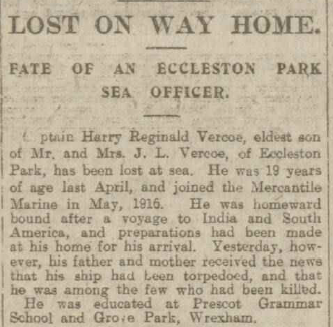
The announcement of Harry Vercoe's death in the London Times of 20th September 1918
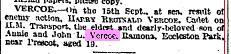
Liverpool Echo announcement on 18th September 1918
Serving on the SS Kendall Castle, Harry Vercoe was lost when the ship was sunk four miles S.E. of Berry Head on 15th September 1918. She was en-route from Le Havre to Cardiff in ballast. Casualties were 18 including the master.
She was built in 1910, a 3,885 gross tons steamship owned by the Lancashire Shipping Co. and managed by James Chambers & Co. ('in British Merchant Ships Sunk by U-boats in the 1914-1918 War', A. J. Tennant).
The sinking was for a long time attributed to UB103, however there has been a reassessment of U Boat activity in the area recently, and this has resulted in the sinking being credited to UB104.
Both UB 103 and UB 104 sailed and did not return home (lost with no survivors). The key to determining which one sank Kendal Castle and Gibel Hamam is how the loss of UB 103 is viewed. .
UB 103 sailed on her sixth patrol on August 14, 1918 from Flanders. The British claim made Immediately after the war, and based upon the Royal Navy's incomplete knowledge of German submarine operations, was that she was sunk on September 16 off Griz Nez. There was also a British claim that the wreck was found by divers.
From a U-boat operations standpoint, this is an extremely ugly attribution. Flanders-based boats didn't do 33 day plus patrols going through Dover. The longest patrol for a Flanders UBIII-based operating through Dover that returned home was only 22 days. UB 103's orders where to stay out no more than 18 days.
UB 103's commander was Kplt. Paul Hundius, an extremely able and aggressive submarine commander. Just after UB 103 sailed for the final time, he was awarded the Pour le Merite. The only sinking linked to UB 103 on her final patrol are the Gibel Hamam and Kendal Castle on September 14 and 15 respectively. The attribution seems to be a case of working backward from a presumption that UB 103 was sunk off Griz Nez on the 16th.
Robert Grant examined the September 16 claim in his recent book 'U-Boat Hunter's. He rejects it, noting the excess patrol length. Grant also examined British primary source documents. These show that the Royal Navy did NOT find a U-boat wreck when they searched the area where UB 103 was supposedly sunk. The official German history by Admiral Arno Spindler also notes the excess patrol length and does not accept the British claim. (The Gibel Hamam and Kendal Castle attributions (like all others) actually come from Spindler, but this is a misinterpretation -- Spindler says that IF the Griz Nez claim were true THEN UB 103 could be credited with the two sinkings.)
A few years ago, Dr. Axel Niestle (author of German U-Boat Losses During World War II) and Michael Lowrey sorted through the Flanders UBIII losses. Axel had done some research in this area as part of an effort to identify an UBIII found off the Cornwall coast for a TV program. Lowrey was working with Belgian divers to identify a number of UBIIIs off the coast there. It was agreed by Niestle and Lowrey that the sinking of Gibel Hamam and Kendal Castle should be credited to UB 104. (They also agreed that UB 103 in all likelihood hit a mine soon after sailing and is one of the UBIII found by divers off the Flanders coast. The locations match British minefields lain in June and July 1918.)
UB 104 sailed on September 6th 1918 for the English Channel via the north of Scotland (not through Dover). She radioed after crossing the Northern Barrage and is credited by Spindler with a number of sinkings, beginning on September 16 with the Ethel, which was sunk very near where Kendal Castle went down.
(For much of the information shown above, I am indebted to the following 'Pals' of the Great War Forum; John (aka Spithead), Arthur, David (aka Historydavid) and Michael Lowrey, who provided the details on the re-crediting of the sinking to UB 104.)
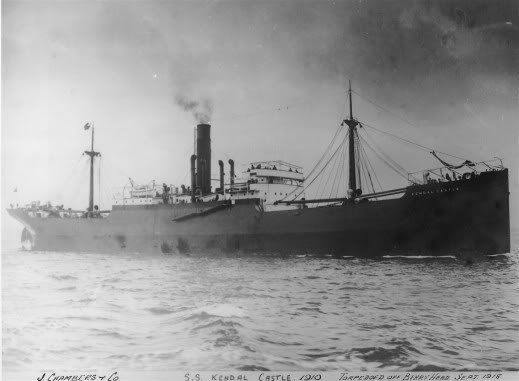
A picture of the "Kendal Castle" in 1910. (C) Liverpool Maritime Museum.
Member Comments(0)
Please select a letter for a surname list:
|