WW1 Casualty: Private 17936 Joseph William Taylor - Private 17936 Joseph William Taylor

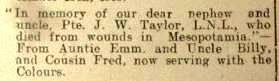
Prescot Reporter 19/10/1916
| Unit/Regiment |
6th Bn., Loyal North Lancashire Regiment |
| Date of Death |
26/03/1917 |
Age at Death |
20 |
Burial/Memorial
& Reference |
Basra War Cemetery
IV J 4 |
| Census Details |
1901 Census -
The Taylor family lived at 47, Kemble Street, Prescot. Joseph Taylor was 27 year old Coal Miner and a native of Longton in Staffordshire. His wife Ellen was also 27, and their children were Rebecca (6), Joseph (4) and 1 year old Ellen.
1911 Census -
The Taylor family now lived at 87, Kemble Street. 37 year old Joseph was a "Daywage Miner" and had been married to Ellen (also 38) for 10 years. Of their 10 children, 5 were still alive, all living with their parents. 15 year old Joseph was a Brass Driller at the Wire works, Rebecca was aged 16 but not recorded as working, George (7) and Elsie (11) were at school, and Ellen was aged 2. This suggests that the 1 year old daughter also called Ellen in 1901, was one of the children who had died. |
| Birth/Marriage/Death Registrations |
Birth Registered Q4/1896, Prescot. Volume, 8b, Page 715 |
| SDGW - Where Born |
Prescot, Lancs |
| Enlisted |
Liverpool |
| How Died |
Died of Wounds |
Theatre of War |
Mesopotamia |
| Research Ref. No. |
P273 |
Service DetailsThe 6th (Service) Battalion of the Loyal North Lancashire Regiment was formed on 8th August 1914 and Joseph Taylor's service number is in a range issued in early November of that year. His number, 17936, is just 4 away from Pte. William Critchley (also on this site), which suggests that perhaps the men were friends who enlisted on the same day.
Initial training of the battalion took place on Salisbury Plain but the battalion moved on to Blackdown, near Aldershot, early in 1915.
Around this time, it had been decided that the force in Gallipoli needed to be reinforced and the 6th Battalion was part of the 13th Division, which was chose for this task. Consequently, in early June of 1915, the battalion entrained at Farmborough for Avonmouth.
The battalion boarded s.s. 'Braemar Castle' immediately but only sailed on 17th June. Steaming via Malta, Alexandria and Mudros, they finally landed at Cape Helles on the night of 6th July and immediately went into bivouacs. Within a short time they were in the front line trenches where they remained for most of July, suffering their first casualties. Towards the end of the month they were relieved and sent back to Mudros, but were back on the Peninsula by 4th August.
They were heavily involved in the fighting at Chunuk Bair, reporting 10 officers and eight other ranks killed, 30 wounded and no less than 445 missing, the majority of whom were 'presumed killed'. In fact, 'Soldiers Died in the Great War' reports 241 of the battalion being killed in the whole of August.
Eventually, the battalion was evacuated from Gallipoli as part of the overall withdrawal from the peninsula, and on 20th December 1915 they sailed on the s.s. 'Huntsgreen' for Mudros. A month ot so later they embarked for Alexandria and then on to Port Said.
Around this timer, the force led by General Townsend had become besieged at Kut in Mesopotamia and the 6th Battalion of the Loyals was chosen to take part in a relief attempt. They left Port Said on the 14th February and arrived in Kuwait Bay on the 27th. Then on the 3rd March, they proceeded up the Shatt-al-Arab waterway into Mesopotamia, reaching Basra on the 5th.
Despite the presence of the battalion, the garrison at Kut surrendered in late April. Throughout the remainder of 1916, the battalion was enaged in several operations aginst the Turksish forces in and around Baghdad. Eventually by early 1917, they formed part of a force tasked with crossing the Diyala River, close to Baghdad as part of the British attack on Turkish forces which ultimately led to the fall of that city. Given the date of Private Taylor's death, it seems likely that he was wounded in this action and ultimately succumbed to his wounds.
A party of about 100 of the battalion crossed the river on the night of 9th/10th March 1917, using pontoons, but having landed they then had to hold out against repeated Turkish attacks without resupply until 4.00 a.m. on the 10th. 4 officers and 31 men were killed in this action, 67 were wounded and 2 were posted as missing.
Captain O A Reid was awarded the Victoria Cross for his part in this action.
General Maude's report of the actions around this time reads:-
'It now became evident that, although the line of the Diyala was not held strongly, it was well defended by numerous guns and machine guns skilfully sited, and the bright moonlight favoured the defence.
To assist in forcing the passage a small column from the force under Lieut.-Gen. Marshall was ferried across the Tigris in order to enfilade the enemy's position with its guns from the right bank of that river.
During the night of the 8th-9th, after an intense bombardment of the opposite bank, an attempt was made to ferry troops across the Diyala River from four separate points. The main enterprise achieved a qualified success, the most northern ferry being able to work for nearly an hour before it was stopped by very deadly rifle and machine-gun fire, and we established a small post on the right bank.
When day broke this party of seventy of the Loyal North Lancashires had driven off two determined counter-attacks and were still maintaining themselves in a small loop of the river bend. For the next twenty-two hours, until the passage of the river had been completely forced, the detachment held on gallantly in its isolated position under constant close fire from the surrounding buildings, trenches, and gardens, being subjected to reverse as well as enfilade fire from distant points along the right bank.
On the morning of March 10th our troops were again engaged with the Turkish rearguard within three miles of Baghdad, and our cavalry patrols reached a point two miles west of Baghdad railway station, where they were checked by the enemy's fire.
A gale and blinding dust storm limited vision to a few yards, and under these conditions reconnaissance and coordination of movements became difficult. The dry wind and dust and the absence of water away from the river added greatly to the discomfort of the troops and animals.
About midnight patrols reported the enemy to be retiring. The dust storm was still raging, but, following the Decauville Railway as a guide, our troops occupied Baghdad railway station at 5.55 a.m., and it was ascertained that the enemy on the right bank had retired upstream of Baghdad. Troops detailed in advance occupied the city, and the cavalry moved on Kadhimain, some four miles northwest of Baghdad, where they secured some prisoners.'
The Parish Magazine of 26th April 1917 reported 'The following have fallen in the present fighting on various battlefields' and included 'Pte. Joseph William Taylor, 20, Loyal N. Lancs., of Scotchbarn Lane, March 1917'.
Prescot Reporter 17th September 1917.
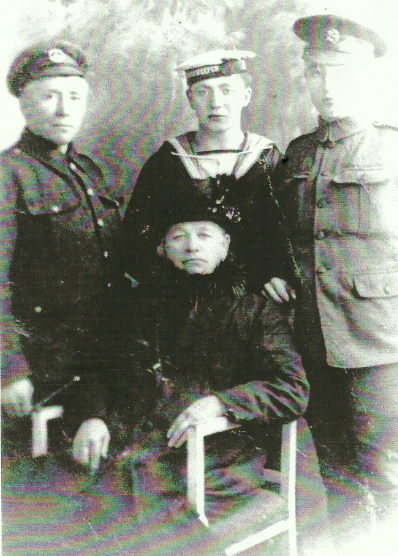
I was recently passed the photograph below by Brian Apps, a relative of J W Taylor. Brian states that the man standing on the right is believed to be Joseph, but the other two servicemen and the lady in front are unidentified.
Perhaps this is Aunty Emm and 'Cousin Billy' referred to in the extract from the Prescot Reporter (see above)?
If you can help identify these people, then please get in touch
Joseph Taylor's Medal Index Card. He first served in Gallipoli before moving to Mesopotamia.
Member Comments(0)
Please select a letter for a surname list:
|