WW1 Casualty: Private 10209 John Thomas Boadey - Private 10209 John Thomas Boadey
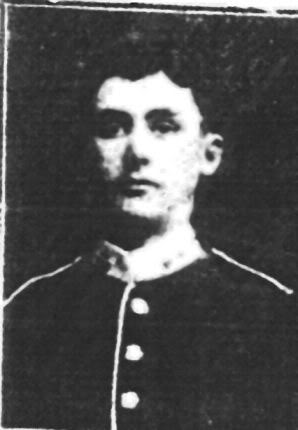
Prescot Reporter 31/12/1915
| Unit/Regiment |
2nd Bn., South Lancashire Regiment |
| Date of Death |
25/09/1915 |
Burial/Memorial
& Reference |
Menin Gate
Panel 37 |
| CWGC Family Details (if shown) |
Birth Registered Q1/1896, Prescot, 8b, 693 |
| Census Details |
1901 Census -
Although born in Prescot, by the time of the 1901 census, John Thomas Boadey was living at 9 Gas Street, St Helens with his parents John Henry Boadey, a 35 year old coal weaver and mother Elizabeth, aged 32.
1911 Census -
The Boadey family had by 1911 moved to 20, Harvey Lane, Golborne. John, a 43 year old Coal Miner, had been married to Elizabeth, 41, for 16 years. Of their 9 children, just 2 were still alive and John had inadvertently completed details of the deceased children on the census form. Sarah (7) and John (15) had survived, and John was working as a Scavenger at the Cotton Mill. The children who had died were shown as James (1 day), Elizabeth (3 months), Christopher (3 months), Mary (11 months), Edward (5 weeks), Mary Ann (2 months) and Albert (3 months) |
| SDGW - Where Born |
Prescot, Lancs |
| Enlisted |
Warrington, Lancs |
| Resided |
Golborne, Lancs |
| How Died |
Killed In Action |
Theatre of War |
France & Flanders |
| Research Ref. No. |
P020 |
Service DetailsThe 2nd Battalion of the South Lancashire Regiment landed in France on 14th August 1914, just over a week after the outbreak of war. They disembarked at Le Havre with a strength of 27 officers and 980 other ranks, and then travelled by train to Mauberge.
They marched over the next few days through areas of northern France where the civilian population turned out in droves to meet and salute them, ultimately arriving at St Hilaire on the 20th. On the 21st, they again marched off, this time towards the Belgian border, finally arriving at Framieres in the late afternoon of the 22nd. They were then informed that the Germans had occupied Brussels and that the next day they would be moving forward to engage the enemy.
On the morning of the 23rd they marched off and by mid-afternoon they could see shells bursting over Mons some two miles away. Battle was imminent. By 5.30, they were entrenched and ready for action.
Early next morning, the 24th, shortly before 4 a.m., the German infantry in masses and firing from the hip, came straight for the positions occupied by the Battalion, and were met by the defenders with rifle and machine-gun fire.
The battle raged for several hours and over 1,000 German troops were estimated to have been killed. But after several hours of intense fighting against overwhelming odds, the Battalion was forced to retire from their positions covering the Mons-Conde canal to avoid being outflanked. The retreat from Mons had commenced. By the time the Battalion reached Coyelles on the 29th and was able to regroup, the muster amounted to 14 officers and about 400 men, about half of its original strength.
The Battalion engaged in several more conflicts throughout the remainder of 1914, receiving well-needed replacements in December, by which time it was based in trenches east of Kemmel, and billeting in Balleul when out of the line.
1915 saw a continuation of the trench warfare which defined the latter stages of 1914, ending up in August based in the Sanctuary Wood area, ready for the attack on the Bellewaarde Ridge, scheduled for 25th September.
The attack, targeting the German trenches in the vicinity of Hooge and Bellewaarde was a diversionary tactic, designed to contain the enemy reserves whist the attack on Loos took place further south.
The men marched to their positions on the 24th through a torrential downpour, resulting in them spending the night in wet clothes awaiting zero hour.
At 4.20 a.m. 'A' and 'B' companies moved over the parapet and headed for the ruins of Hooge Chateau. The Germans launched a withering machine-gun attack on the troops, and 'A' company retired when they found that the wire on their front had not been cut. 'B' company managed to reach the German trenches and several men entered and engaged in hand-to-hand fighting with the Germans, but all were killed as support could not reach them, 'B' company losing 114 out of 170 of all ranks.
The attack failed to make any impact and came to an end. In a few short hours, the battalion lost 2 officers and 26 Other Ranks killed with 6 officers and 222 OR wounded or missing.
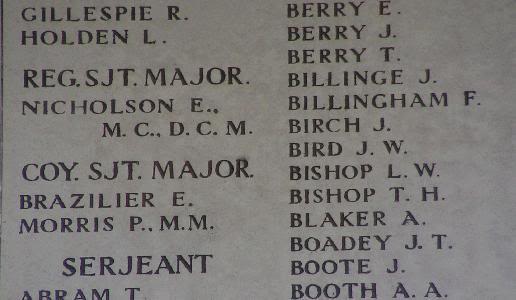
Pte. Boadey was one who fell in the fighting. He has no known grave and is remembered on the Menin Gate memorial to the missing.
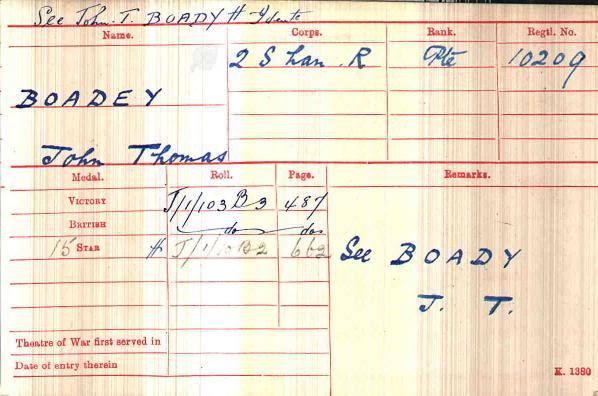
John Boadey's Medal Index Card. For some reason, a duplicate card was also created, although both cards refer the reader to the other
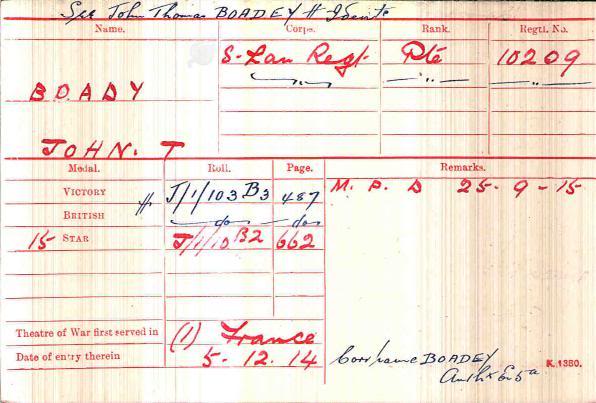
Private Boadey's Second Medal Index Card
Private Boadey's inscription on the Menin Gate
Announcement in Prescot Reporter, 14th September 1917
The Parish Magazine of 24th September 1918 added to the list of honour a further set of names, including 'Pte. John Boadey, 19, 2nd S. Lancs., who fell at Loos on 25th September 1915'.
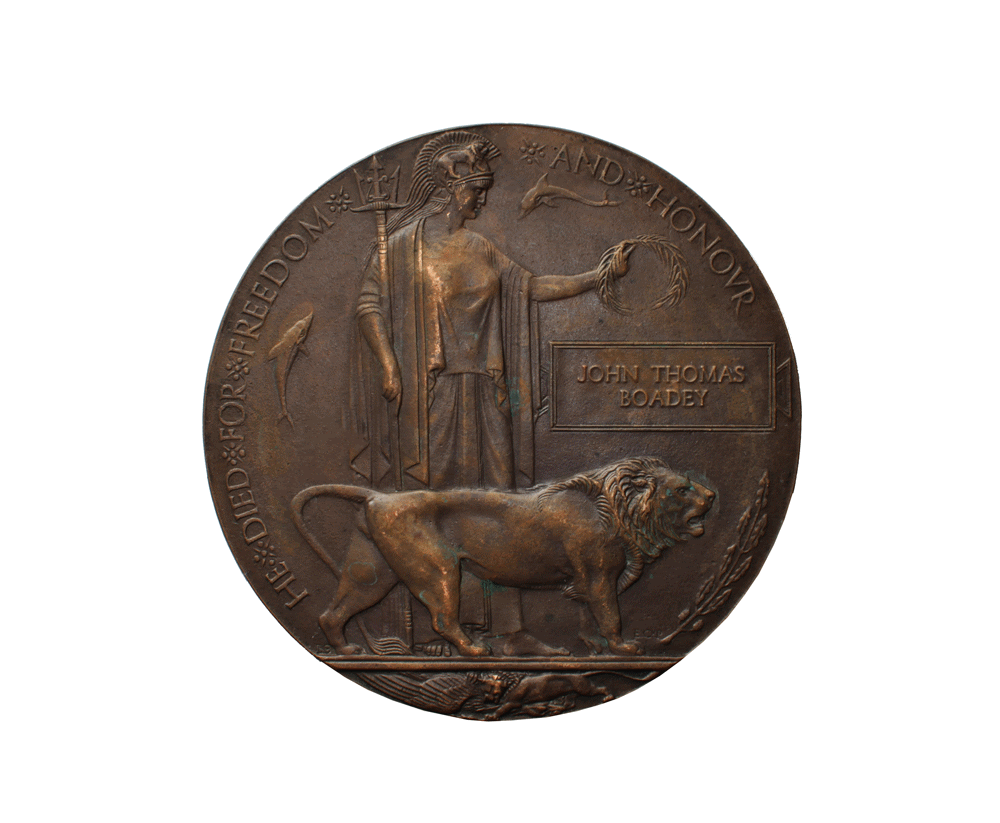
This image, kindly provided by John Boadey's family, shows his Memorial Plaque
Member Comments(0)
Please select a letter for a surname list:
|