WW1 Casualty: Corporal 27153 John Orton - Corporal 27153 John Orton

Prescot Reporter 27/04/1917
| Unit/Regiment |
2nd Bn, South Lancashire Regiment |
| Date of Death |
12/04/1918 |
Age at Death |
21 |
Burial/Memorial
& Reference |
Ploegsteert Memoria
Panel 6 and 7 |
| Census Details |
1901 Census -
John Orton was aged 5 and lived with his parents John, a 36 year old Coachman, and Gertrude (33) at Cowley Hill Lane in St Helens. Also present were his sister Clara (8) and brother William (2). Only William had been born locally (in Wavertree), the others being from York, Durham and Norfolk.
1911 Census -
The Orton family lived at Hamer Street in St Helens. By now, Gertrude was aged 42 and widowed but working as an Office Cleaner at the Labour Exchange. Living with her were sons John, aged 15 and working as a Carrier at Pilkington Brothers, and William, a 12 year old schoolboy.
|
| Birth/Marriage/Death Registrations |
Birth registered Q3/1896, Durham, Volume 10a, Page 429 |
| Enlisted |
Warrington, Lancs |
| How Died |
Killed in Action |
Theatre of War |
France & Flanders |
| Research Ref. No. |
P214 |
Service DetailsJohn Orton joined the army on 7th March 1916 at Warrington. At that time he lived at 10, Eccleston Street, Prescot and worked as a Wire Drawer at the Cable Works. He was 20 years old, almost 21. He recorded his mother as next of kin, living at the same address.
Initially posted to the Depot Battalion at Warrington, on 19th April 1916 John was appointed as unpaid Lance Corporal and posted to the 10th Battalion, still at Warrington. He sailed for France on 17th July 1916, being then posted to the 2nd Battalion.
Early in 1917, he was assigned to the Army Provost Marshal (Military Police) at Rouen. Ironically, in May of 1917 he was relieved of his rank of Lance Corporal for being drunk when reporting for duty!
He returned to the 2nd Battalion in September of 1917, and quickly regained his rank of Lance Corporal, and was promoted to full Corporal on 23rd December.
At the beginning of 1918, the 2nd Battalion were located in the Lagnicourt sector, opposite the notorious Hindenberg Line. In February, owing to the shortage of manpower, the 8th (Service) Battalion ceased to exist, its men being transferred into the 2nd Battalion.
It was clear that there was additional activity in the German lines, and a corresponding increase in the activity of German aircraft. The German offensive finally began on the 21st March and the battalion was in the thick of the fighting until the night of the 26th, when they were withdrawn, marching to billets at Lanches which they reached on the 28th.
In the 5 days of the initial offensive, they had lost 13 officers and 360 other ranks, killed, wounded and missing. Upon the arrival at Lanches of reinforcements of 15 officers and 343 other ranks, the battalion was reorganised with 4 companies, 'A' to 'D'.
The battalion was ordered to replace the Australians at Ploegsteert and by 2nd April they occupied trenches some 2,000 yards east of the ruined village. They remained here until the 8th, when they marched back to the Rosignol rest area. However early the next morning, heavy shellfire was heard to the south, towards Armentieres and word was received that the enemy had broken through. The battalion was ordered to stand to, ready to move at a moment's notice.
The battalion remained on stand by in support of the 8th Border Regiment and 11th Cheshires up to midnight on the 9th.
The next morning the Germans advanced towards Ploegsteert and the battalion was ordered to occupy a position on the high ground, 2,000 yards west of the village. At 3.30 p.m. it was decided that a counter attack against Ploegsteert should take place, timed for 5 p.m. The attack was reasonably successful, but was held up by a large number of skillfully handled German machine guns.
The battalion remained in the thick of the action and on the night of the 11th/12th, all was reasonably quiet, but the early morning brought with it a heavy bombardment and the news that the Germans had broken through on the right. A defensive flank was formed on the Romarin - Neueve Eglise Road, but for several hours afterwards all was quiet. At 2.00 p.m., however, the enemy attacked in force and despite a sterling resistance, the companies in the front line were driven back to a position south east of Neuve Eglise where they dug in again.
Corporal Orton was one of 34 men of the battalion who were killed in action that day. Most of them, like John Orton, have no known grave and are remembered on the Ploegsteert Memorial.
In August of 1918, the War Office informed the Army records Office that the previously unofficial report of Corporal Orton's death was now accepted as sufficient evidence for official purposes, and that his date of death was to be recorded as 10th - 12th April 1918.
In 1920, the Army Record Office wrote to Gertrude, John Orton's mother, asking her to supply full details of all his living relatives so that the medals could be assigned to the correct person.
She replied to say that she now lived at 50, Market Place, Prescot with her son William Harold Orton, aged 2, and daughter Clara Gertrude Orton, aged 27.
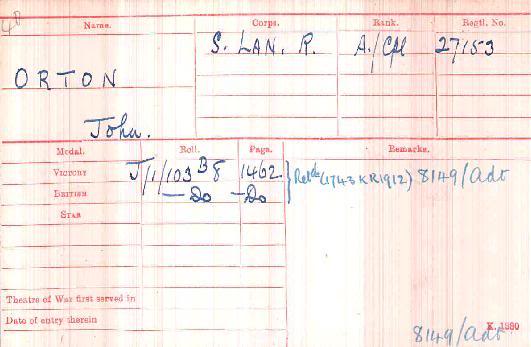
John Orton's Medal Index Card. His entitlement was to the British War Medal and Victory Medal
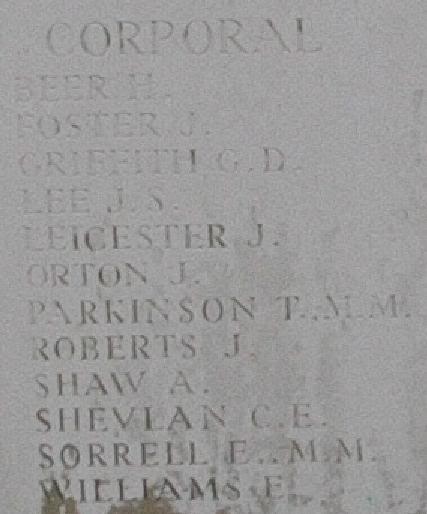
John Orton's inscription on the Ploegsteert Memorial
Member Comments(0)
Please select a letter for a surname list:
|