WW1 Casualty: Private 3357 John Reginald Morris - Private 3357 John Reginald Morris

| Unit/Regiment |
1st/10th Bn, King's (Liverpool Regiment) |
| Date of Death |
16/06/1915 |
Age at Death |
30 |
Burial/Memorial
& Reference |
Menin Gate
Panel 4 and 6 |
| CWGC Family Details (if shown) |
Son of William and Margery Ellen Morris, of Ellesmere House, Denton's Green, St. Helens, Lancs |
| Census Details |
1901 Census -
The Morris family lived at 10, Cowley Hill Lane, St Helens. William Morris, aged 54, was a Corn Traveller and lived with his wife, shown as Margery Esther (sic), aged 44 and children John Reginald (16, a Works Chemists Assistant), Emma Gertrude (14), Margery Ellen (10) and Gordon Gilbert Morris, aged 4.
1911 - Sees 26 years old 'Chemist (Alkali Works)' John still single and living at 33, Vincent St, St Helens. |
| Birth/Marriage/Death Registrations |
Birth registered Q4/1884, Prescot, Volume 8b, Page 749 |
| SDGW - Where Born |
St Helens, Lancs |
| Enlisted |
Liverpool |
| Resided |
Prescot, Lancs |
| How Died |
Killed in Action |
Theatre of War |
France & Flanders |
| Research Ref. No. |
P204 |
Service DetailsJohn Morris was originally from 121 Swinley Road in Wigan. He enlisted in the 10th Battalion King's (Liverpool) Regiment, known as the Liverpool Scottish, at Liverpool on 29th August 1914, aged 28 years and 11 months. He was employed as an Analytical Chemist, was 5' 7" tall, weighed 142 lbs and had very good physical development. By this time, his address was Lyme Grove, Prescot, but his next-of-kin was shown as his sister, Margery, who still lived at Swinley Road in Wigan.
He embarked for France at Southampton on 10th March 1915, arriving there the following day.
At the end of the 1st Battle of Ypres in June 1915, the German trenches between the Menin Road and the Ypres-Roulers railway formed a salient. Behind their front lines lay the Bellewaarde Ridge and lake, giving the Germans good observation over the British lines. Early in June, it was decided to attack the salient and to try to gain possession of the ridge.
Several units were to be involved in the attack, with the Liverpool Scottish, part of the second wave. During the first wave, they were to move up into the line vacated by those troops involved in the first wave and then go on to assault the third objective, the south-western corner of Bellewaarde Lake.
At 4 p.m. on the 15th June, the Liverpool Scottish moved into position in Railway Wood. About half an hour after midnight, the Germans launched a heavy artillery barrage on the trenches, resulting in several casualties both killed and wounded.
At 4.15 a.m. on the 16th June, following a preparatory artillery bombardment, the Liverpool Scottish left their trenches and crossed No Mans Land. Without much resistance the first German line was captured, the many dead and wounded Germans clearly showing the effect of the preliminary bombardment. The battalion then moved on and cleared the second German line without too much difficulty, but now came under fire from their own guns!
The troops had been supplied with large red and yellow screens which they were to erect to inform the artillery observers of their positions. However they could not be seen and the artillery continued to target the German lines, not realising that they had been occupied by the British troops. Although the third German line at the lake was reached, they had to withdraw due to losing heavily from their own guns. In addition, the German artillery had now started to target the battalion and counter attacks were under way. There was a great deal of hand to hand fighting in which both sides lost heavily.
By 9.30 a.m., the battalion was back in the captured German second line where they remained until relieved just before midnight.
The operation had captured around 1,000 yards of German front line trenches at heavy cost. Of the 24 officers who went into the action, only three came away unscathed, including Lt. Noel Chavasse. The battalion lost 379 other ranks killed, wounded and missing, almost half of their strength.
Private Morris was one of those killed. He has no known grave and is remembered on the Menin Gate.
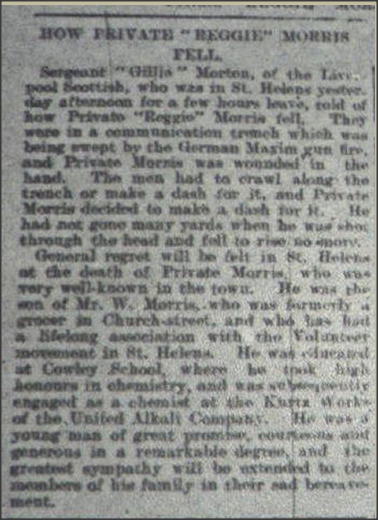
How Pte Morris' death was reported in the St Helens Reporter. Courtesy Ste M.
After his death, his belongings were sent to his sister Margery, who still lived at the Swinley Road address. She received these in October 1915. Margery, later married and now Mrs. Boardman, wrote to the Records Office on 12th July 1922 stating that she intended to visit the battlefields, and asking for details of her brother's grave location. No details of any reply are recorded, and it is not clear if she went ahead with her planned visit.
Private Morris's medal entitlement was recorded as the 1914-1915 Star, British War Medal and Victory Medal, as shown on the Medal Index Card below.
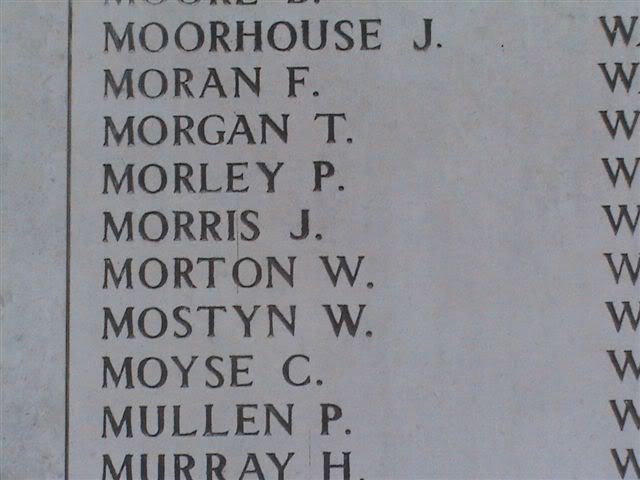
John Morris's inscription on the Menin Gate
Member Comments(0)
Please select a letter for a surname list:
|