WW1 Casualty: Private 13162 Walter Jaundrill - Private 13162 Walter Jaundrill

Prescot Reporter 01/09/1916
| Unit/Regiment |
17th Bn., King's (Liverpool Regiment) |
| Date of Death |
30/07/1916 |
Age at Death |
35 |
Burial/Memorial
& Reference |
Thiepval Memorial
Pier and Face 1D 8B and 8C |
| Census Details |
1891 Census -
Living at 56 Sewell Street, Prescot, were John Jaundrill, a 53 year old coal miner, his wife Ann (49), and children William (20), Martha (18), John (13) and Walter (10)
1901 Census -
Head of household John is by now aged 62 and is a labourer at the Wire Factory. His wife Ann is 59 and children John, 23, is a Stationary Shunter, Walter (20) is a Coalminer - Drawer and Annie is aged 13.
1911 Census -
By this time, Walter had been married to Annie (nee Lloyd) for 3 years and they lived at 38, Warrington Road, Prescot. They had a 2 year old daughter, Amy |
| Birth/Marriage/Death Registrations |
Birth Registered Q4/1880, Prescot, 8b, 625
Marriage to Annie Lloyd, Q4/1907, Prescot, Volume 8b, Page 1100
Children identified – Ann (Q4/1911) and Walter (Q4/1913) |
| SDGW - Where Born |
Prescot, Lancs |
| Enlisted |
Seaforth, Lancs. |
| Resided |
Prescot, Lancs |
| How Died |
Killed In Action |
Theatre of War |
France & Flanders |
| Notes |
Some sources have the surname spelt as "Jaundrell" |
| Research Ref. No. |
P166 |
Service DetailsWalter Jaundrill enlisted on 24th August 1914. Initially serving with the 11th Battalion of the regiment. He embarked for France on 19th May 1914 and then transferred to 17th Battalion on the 11th June 1916.
He was listed on the Nominal Roll of the 11th Bn which was taken on 20th December 1915 at Ypres.
The 11th Bn held the distinction of being the first of the New Army battalions raised by Lord Kitchener. It came into being at Seaforth on 24th August 1914. Training commenced at Barossa Barracks, Aldershot and then on 28th November they moved to Farnham. On the 11th January 1915 the battalion was redesignated as a Pioneer Battalion and became 11th Battalion King's Regiment (Pioneers), the first of many Pioneer battalions formed during the war. As we as their ordinary infantry training the Pioneers now underwent a course of bridge building, mine digging, bridge building and trench construction.
On 20th March 1915 they moved to Watts Common, Farnborough where they remained unto 19th May, when the entrained for Folkstone, crossing to Boulogne on 19th, arriving the following day.
On 25th the received orders to proceed to Vlamertinghe for attachment to the second army. At 6:15 on the 26th they travelled in 45 London omnibuses, marching the final stage to the chateau at 9.15a.m. They were immediately sent off to the Yser Canal strengthening existing defences and making communication and support trenches. Here they had their first casualties, four men being wounded by enemy shrapnel bursting overhead.
On 11th June 1916 Private Jaundrill transferred to the 17th Battalion.
The battalion returned to front line trench duty on the night of the 17th/18th June at Maricourt. By this time, the planning and preparations for the Somme offensive were well under way. On 24th June, the preliminary bombardment commenced and it was 2 days before the Germans started to become active in returning the fire. By the end of June the battalion reported 17 other ranks killed and 57 wounded, all of these would have been the result of the German response to the bombardment.
As part of the Somme offensive, the 17th battalion were responsible for the capture of Montauban (popularly known to the troops as 'Montybong'). Under the command of Lt. Col. B.C. Fairfax they moved up to their assembly trenches by 3.30a.m. on the morning of 1st July, These being on the frontage of the Maricourt - Briquerie Road. A French battalion was on their right and 20th (King's) on their left, The German lines were between 200 and 400 yards ahead.
The attack commenced at 7.30a.m. with a swarm of men going 'over the top'. It is worthy of note that this was the first time the new steel helmets had been worn. The battalion advanced quickly across 'No Mans Land' with very little resistance and they quickly took their first objective, known as 'Dublin Trench' by 8.30, the alloted time, and then dug in. The battalion suffered casualties of 3 officers wounded and 100 other ranks killed and wounded.
The battalion also reported the 3rd July as 'a quiet day' although German shelling continued.
Private Jaundrill was officially recorded as 'Killed' on 30th July. His body was never recovered and he is remembered on the Thiepval Memorial.
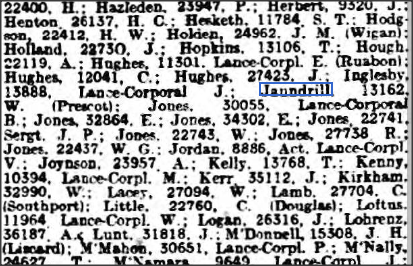
Pte Jaundrill was included in a list of over 4,000 men who were worunded or missing in the Liverpool Mercury of 14th September 1916
Pte. Jaundrill's family must have received notification that he was missing because it seems they contacted the British Red Cross in an attempt to find news of his fate.
The British Red Cross Supplementary List of September 15th 1916 which listed basic details for all men whom the had received an enquiry, included an entry for Pte. Jaundrill which stated that he was 'unofficially missing, 25th July 1916'. It is impossible to know after all this time why he was officially reported as 'killed' dated 30th July.
The Parish Magazine of 28th June 1917 reported 'The following are deaths in action, all in France or Belgium' and included 'Pte Walter Janundrill, 35 of Sewell Street, the King's Liverpool's, killed 30th July 1916, he left a widow and three children.
Prescot Reporter 14th September 1917
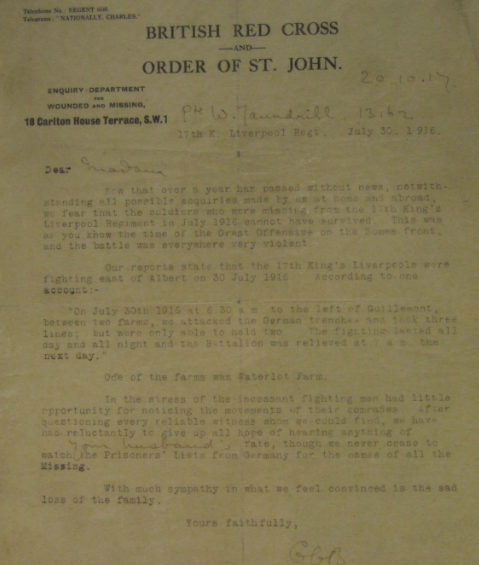
In late October 1917 his widow Ann received a letter from the British Red Cross. The letter is reproduced below.
The Letter from the British Red Cross courtesy of Prescot Museum
(Accession Number 2004.8.2)
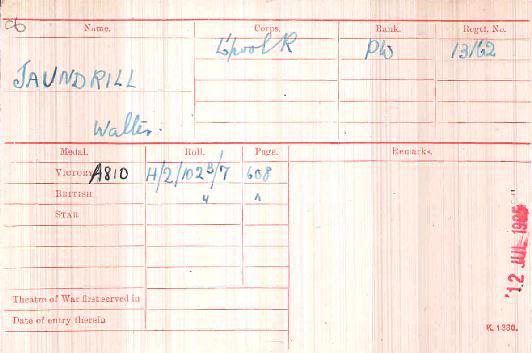
Walter Jaundrill's Medal Index Card
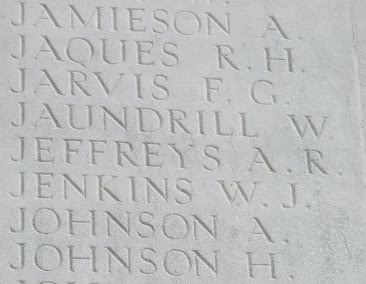
Walter's inscription on the Thiepval Memorial
Picture taken on Monday 21/02/1011
Member Comments(0)
Please select a letter for a surname list:
|