WW1 Casualty: Private 16049 John Grogan - Private 16049 John Grogan

| Unit/Regiment |
'F' Coy, 7th Btn, South Lancashire Regiment |
| Date of Death |
01/04/1917 |
Age at Death |
36 |
Burial/Memorial
& Reference |
Prescot Churchyard
Middle East part |
| CWGC Family Details (if shown) |
Husband of Bertha Burke (formerly Grogan), of 4, Golden Court, Derby St., Prescot |
| Census Details |
1891 Census -
John Grogan is aged 9 and is living in Forbers Court, off Tea Street, Prescot. The family also includes his father John, a 46 year old labourer, mother Mary (38) and children James (17), Annie (12), Andrew (7), Margaret (5), Ellen (3) and Catherine (2). By 1901, John is working as a coal miner and is living with his brother-in-law John Kelly at 3, Cambridge Street, Prescot
1911 Census -
John had been married to Bertha for 3 years and they lived at 5, Golden Court, off Derby Street, Prescot. He was still employed as a Coal Miner. He and Bertha had a two year old son, also called John |
| SDGW - Where Born |
Prescot, Lancs |
| Enlisted |
St Helens |
| Resided |
Prescot |
| How Died |
Died of Wounds |
Theatre of War |
Home |
| Research Ref. No. |
P135 |
Service DetailsJohn Grogan enlisted as Private 16049 into the 7th Battalion, South Lancashire Regiment on 8th December 1914 in St Helens. He was a 33 year old married man and worked as a Collier. He lived at Golden Court, Prescot.
John Grogan's entry in the 1914 Electoral Roll for Prescot
Private Grogan stood 5 foot 7 inches tall, weighed 126 pounds and had a 36 inch chest measurement, expandable by 3 inches. His had 'Good' vision in both eyes and as a result of his medical examination he was passed as Fit for military service.
The 7th (Service) Battalion was formed from the large number of recruits who flocked to the colours as a result of Kitchener's appeal in August 1914. The 6th and 7th Battalions were formed within a few days of each other but the 7th did not receive any uniforms until October, having to wear civilian clothes up to that time.
On 22nd February 1915, whilst at Moor Lane Camp, Private Grogan was charged with overstaying his pass from 7.30 a.m. until 9.00 p.m. and his punishment was to be 'Admonished'. However, he committed the same offence and received the same punishment four weeks later.
The battalion was eventually trained and fully equipped by March 1915 and on 17th July the battalion embarked for France on the SS 'Onward', arriving at Bolougne.
Private Grogan overstayed his leave again in August of that year and perhaps surprisingly was only admonished for a third time!
The 7th Battalion moved into the line for the first time on 28th August, in the Festubert-Givenchy sector. They moved in and out of the line in rotation for several months, enduring the daily grind of warfare, with trench raids, artillery attacks, etc. to contend with.
Private Grogan committed a further offence of overstaying his leave early in 1916, but this time his punishment was to be confined to barracks for 2 days.
In June 1916, the battalion was ready to join the great Somme offensive. On the 1st July, they moved into the line at 9.30, some 3 hours after the start of the assault, and waited for instructions. They were moved around for the next two days, but did not as yet engage the enemy. On 3rd July, they were tasked with an attack on the strongly defended ruins of La Boisselle, although the start time for the attack was not until 9.30 p.m. The attack was fierce and sustained extremely heavy casualties, but the village was finally cleared by bayonet point at 3pm the following day.
The battalion was withdrawn from the line early on 6th July, moving back to rest billets at Albert.
They moved in and out of the line throughout July as the battle of the Somme wore on, until finally at the beginning of August, they moved northwards into Flanders, to the Messines Ridge. They moved on again in September to the vicinity of Ploegsteert but spent a relatively quiet time there before yet again returning to the Somme in October, although the time was uneventful with regard to major incidents.
Private Grogan will have likely been wounded in one of these engagements, perhaps as part of the daily grind of trench warfare and artillery attacks. He ultimately returned home and succumbed to his wounds at Tower Hospital, Rainhill, on 1st April 1917. He rests in Prescot Churchyard.
Strangely, a report appeared in the Parish Magazine (date not known) which read 'Pte. John Grogan, age 36, of 4 Golden Court. 7th South Lancs. Killed in France 30th March 1917. Leaves a widow and 4 children'. It is assumed that a communication error led to the comment that he had been killed in France.
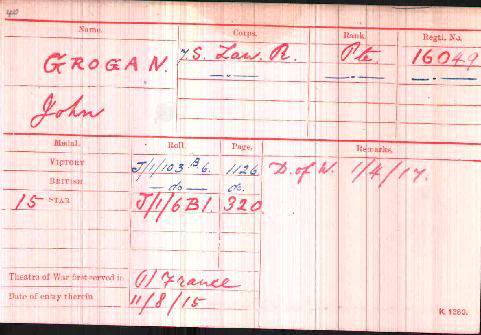
His medal entitlement, as shown on his Medal Index Card below, was the 1914-1915 Star, British War Medal and Victory Medal.
John Grogan's Medal Index Card
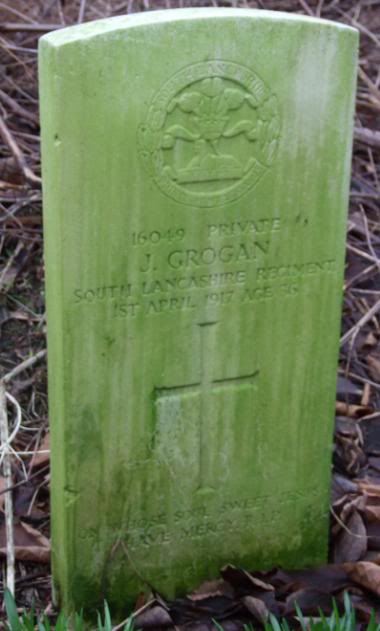
John Grogan's grave in Prescot Churchyard. The stone is heavily covered with moss as it has, until recently, been covered with overgrowth. The condition of the stone has been reported to the Commonwealth War Graves Commission.
The burial register entry for John Grogan
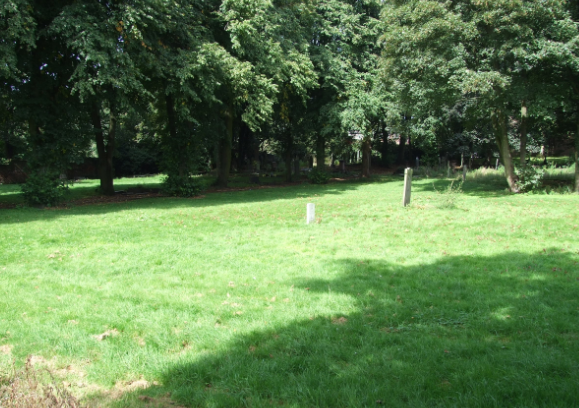
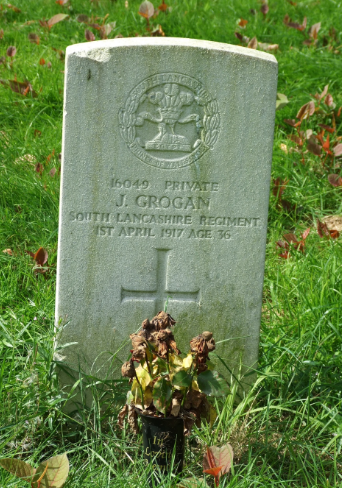
On 8th September 2012, I took the pictures (below) in St Mary's Churchyard. One shows how remote Private Grogan's grave is in the churchyard, whilst the second shows that the stone has been cleaned since I took the first picture
Member Comments(0)
Please select a letter for a surname list:
|