WW1 Casualty: Sapper 426314 Vincent Gallagher - Sapper 426314 Vincent Gallagher

| Unit/Regiment |
422nd Field Coy., RE, Corps of Royal Engineers |
| Date of Death |
30/11/1917 |
Age at Death |
28 |
Burial/Memorial
& Reference |
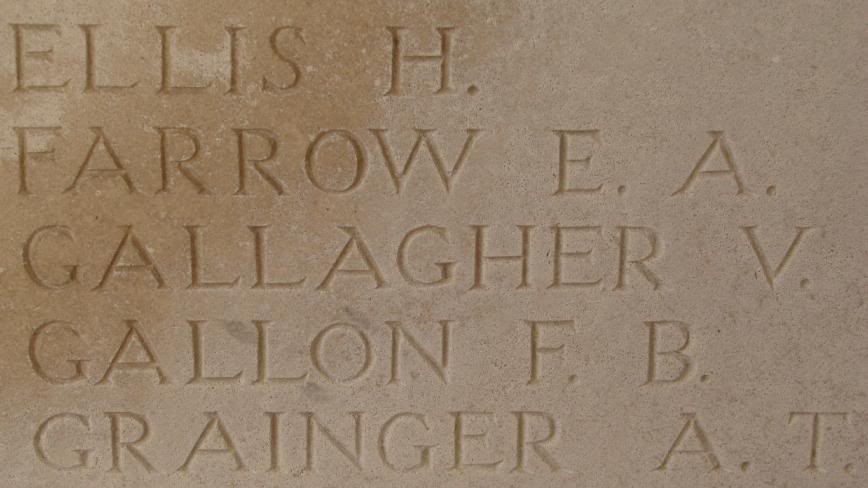
Cambrai Memorial
Panel 1 and 2 |
| CWGC Family Details (if shown) |
Son of James and Mary Gallagher, of 2, Crossfield St., St. Helens. |
| Census Details |
1901 Census -
The Gallagher family lived at 62, Albert Street, St Helens, the home of Vincent's grandmother Mary Evans. Vincent's mother is Mary (37) and also present are Joseph (15), Aloysius (14) and Vincent (12).
1911 Census -
The Gallagher family lived at 65, Albert Street, St Helens. Mary Gallagher, aged 47, lived with her three sons Joseph (25), James (23) and Vincent (22, a Brick Layer) |
| SDGW - Where Born |
Prescot, Lancs |
| Enlisted |
St Helens |
| How Died |
Killed in Action |
Theatre of War |
France & Flanders |
| Notes |
Although Vincent Gallagher is recorded as being born in Prescot, no links with the town could be determined. He almost certainly lived all his life in St Helens but his details have been retained as the research had already been undertaken when it was determined that he was a St Helens man.
|
| Research Ref. No. |
P118 |
Service DetailsAlso commemorated on St Helens Rolls of Honour
Vincent Gallagher attested for military service in St Helens on 5th October 1914. he was 25 years and 9 months old, worked as a Brick Layer and lived with his parents in Albert Street, St. Helens. He recorded that he had been born in Prescot and his parents, as next of kin, were recorded as James and Mary Gallagher of the same address.
His medical exam noted that he stood 5 foot 9 inches tall, weighed 120 pounds and had a 34 inch chest measurement, expandable by 3 inches. He had a pale complexion with brown eyes and dark hair. As a result of his examination, he was passed as fit for military service.
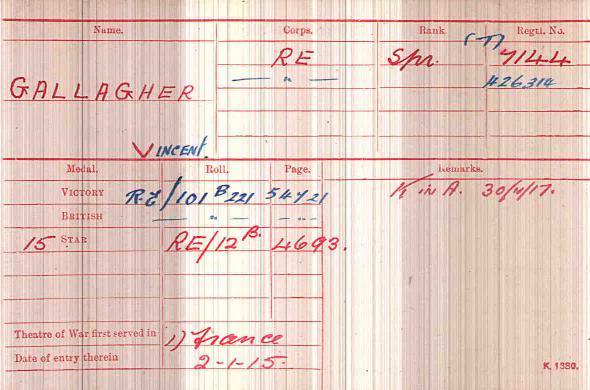
He was posted as a Sapper with the Royal Engineers, his original number being 7144 (he was later renumbered to 426314).
After initial training Sapper Gallagher embarked for France on 31st December 1914, arriving there the following day. His records show that he remained in France until 11th July 1915, when he returned to the UK. He had been wounded on 27th June, receiving a Gun Shot Wound to the scalp whilst serving in the field, and was returned to the UK for treatment at Edinburgh War Hospital, being admitted on 13th July.
A medical report stated that Vincent Gallagher had suffered from Suppurative Otitis Media, a chronic ear infection, for some time. It went on to say, 'On June 27th 1915, he was buried as a result of a shell striking the roof of his dugout on the banks of the Yser. Received a blow on frontal region of head, followed by great swelling and X-Ray showed no damage to skull. Patient suffered from head giddiness for some time afterwards. He was admitted to hospital on 13th July 1915 with some giddiness and contusion of the skull. Was then found to have discharge from both ears.'
The report then went on in medical terms to discuss Vincent Gallagher's ear infection.
A later report showed that he was recovering well and he was deemed fit for Garrison Duty, also being fit for overseas service. He remained an in-patient until 27th August 1915.
On 16th October 1915, while based at Weston Camp, Vincent Gallagher was placed on a change for 'Disobeying lawful commands given by a superior officer'. As punishment for this, he was ordered to forfeit two days pay.
He returned to duty in France on 14th January 1916 and did not return to the UK again.
Sapper Gallagher's unit, the 422nd Field Company, will likely have been tasked with support in the Battle of Cambrai in November and December of 1917. Sir Douglas Haig described the object of the Cambrai operations as the gaining of a 'local success by a sudden attack at a point where the enemy did not expect it' and to some extent they succeeded. The proposed method of assault was new, with no preliminary artillery bombardment. Instead, tanks would be used to break through the German wire, with the infantry following under the cover of smoke barrages. The attack began early in the morning of 20 November 1917 and initial advances were remarkable. However, by 22 November, a halt was called for rest and reorganisation, allowing the Germans to reinforce. From 23 to 28 November, the fighting was concentrated almost entirely around Bourlon Wood and by 29 November, it was clear that the Germans were ready for a major counter attack. During the fierce fighting of the next five days, much of the ground gained in the initial days of the attack was lost. For the Allies, the results of the battle were ultimately disappointing but valuable lessons were learnt about new strategies and tactical approaches to fighting. The Germans had also discovered that their fixed lines of defence, no matter how well prepared, were vulnerable.
The records show Sapper Gallagher reported as being Killed in Action on 30th October 1917. His body was never identified and he is remembered on the Cambria Memorial in Louveral, France.
The Army Records Office wrote to his father in October 1919 asking for details of all living family members in order that the Memorial Scroll and Plaque could be disposed of correctly. His father replied to say that Vincent Gallagher was single and that his only living relatives were his mother and father. No mention is made of his brothers, who had been present on the 1901 census return.
In May 1920, James Gallagher signed to acknowledge receipt of his son's British War Medal and Victory Medal, then in August 1921, he took delivery of his son's 1914-1914-1915 Star.
Vincent Gallagher's Medal Index Card showing his arrival into France on 2nd January 1915.
Vincent Gallagher's inscription on the Cambrai Memorial
Member Comments(0)
Please select a letter for a surname list:
|