WW1 Casualty: Private 242141 Thomas Fowler - Private 242141 Thomas Fowler

| Unit/Regiment |
2nd/4th Bn., South Lancashire Regiment |
| Date of Death |
02/10/1918 |
Age at Death |
24 |
Burial/Memorial
& Reference |
Sunken Road Cemetery
III E 8 |
| CWGC Family Details (if shown) |
Husband of Gertrude A. Sharp (formerly Fowler), of 6, Duke St., Prescot, Lancs.
CWGC Headstone Inscription -
IN GOD'S KEEPING
NOW WE LEAVE HIM
SHELTERED IN
HIS LOVING CARE |
| Census Details |
1901 Census -
Living at 12, High Street, Prescot, were Joseph Fowler, a 42 year old Green Grocer, his wife Margaret (40) and children Jane (20), John (19, a Watchmaker - Jeweller), Charles (17), Joseph (12), Thomas (7) and William (1).
1911 Census -
Margaret was by now widowed. Living at 12, High Street, where she was a Grocer and Fishmonger, she lived with children Charles (26), Joseph (22) and Thomas (16), all of whom were assisting in the business |
| Birth/Marriage/Death Registrations |
Gertrude Fowler was remarried to George Sharpe in 1922 |
| SDGW - Where Born |
Prescot, Lancs |
| Enlisted |
Prescot |
| How Died |
Died of Wounds |
Theatre of War |
France & Flanders |
| Research Ref. No. |
P116 |
Service DetailsAfter the outbreak of war in August 1914, second and third line battalions were formed within several battalions of the regiment; the second line battalion would be equipped and trained for overseas service whilst the third line battalion would be used for development and training of men ultimately drafted into the first and second line battalions, as replacements and reinforcements.
The 2nd/4th Battalion of the South Lancs was formed in September 1914 and did much of its training in the south of England. At the same time, it formed part of the force retained in England for home defence, and it carried this role out throughout 1915 and 1916.
Early in February 1917, the battalion was chosen for overseas service and on 15th February it left Frith Barracks and entrained for Folkstone. The battalion comprised 31 officers and 799 men. They arrived in Boulogne the following day, stayed in Hazebrouck for a few days then went to Sailly-sur-Lys in preparation for moving into the line. On 24th, they occupied trenches for the first time near Bois Grenier, where they remained until 4th March.
At this time, it was officially "quiet" on the Lys front, although the British were preparing for what they knew must be coming soon; a German assault. However, "quiet" was a relative term, and few days passed without a casualty of some sort, incurred by snipers, trench-mortars, raids (both attacking and defending), etc.
The battalion remained in this area until October 1917, when it moved to the Ypres sector. Here, they were mainly involved in Pioneer work, although they did serve in the trenches on the Pilckem Ridge.
In 1918 the battalion had been part of the defence against the German attack in March, and by the middle of the year they had moved to Arras, remaining out of the line from the end of July until the 17th August. By this time, the British counter-attacks were making significant headway and attacks on the German lines were becoming more frequent. On 2nd September, a large attack was launched against the Drocourt-Queant system of trenches, where it joined the Hindenberg Line. The battalion were at the forefront of this attack and all the objectives were taken at slight cost.
The battalion was withdrawn from the line into reserve the following day
On 27th September, the battalion attacked the Graincourt Line as part of the assault on the Canal Du Nord. By this time, the trench systems were being left behind, resulting in a more open, flowing fight. The battalion were in place at their assembly point in a sunken road by 5.20 a.m. although they never moved into the attack until after 10.00 a.m. They then moved forward under heavy shell fire to the canal crossing, near lock No. 5, from which they advanced over 1,.000 yards. By 3.30 p.m. the battalion was again on the move, this time ordered to attack Graincourt. They assaulted the village but came under withering machine-gun fire which inflicted severe casualties. By the evening, the assault came to a stop and the troops concentrated on 'mopping up' enemy strong points which were holding out.
Orders were received to take the village of Cantaing the next day which they did with few casualties. The total casualties from the fighting of the 27th and 28th were 20 killed and 90 wounded. On the 29th, the battalion attacked again, near to Proville, quickly capturing the village with 4 men killed and 41 wounded
On 1st October, the battalion was moved into reserve at La Folie Wood
Private Fowler is one of the men wounded over this period of fighting, although records do not show the actual details. He succumbed to his wounds on 2nd October 1918, at one of the local Casualty Clearing Stations and was buried in the Sunken Road Cemetery. Just six weeks later, the war was over.
The Parish Magazine of 29th October 1918 reported 'The following names to be added to the Roll of Honour' and included 'Pte. Thomas Fowler of Cambridge Street, died of wounds 2nd October'.
Thomas was the brother of John Fowler who was killed in action on 6th October 1917.
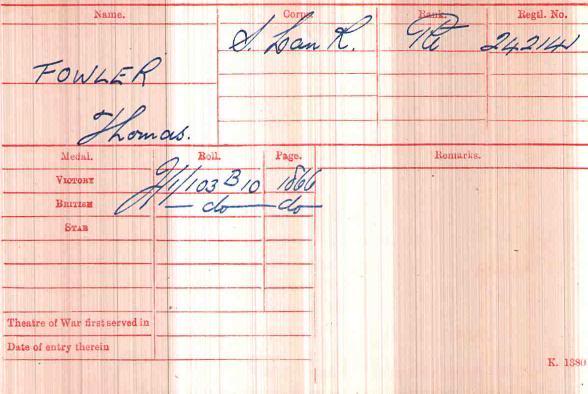
Thomas Fowler's Medal Index Card
Member Comments(0)
Please select a letter for a surname list:
|